
Project Details
The Challenge | Internet on the Ocean
Using floats to provide internet at the ocean
As a solution for internet on the ocean we think about ALLEG, by which we offer a low cost and alternative internet compared to satellite internet. Receiving data by land links, we send to low costs repeaters stations located at the sea.
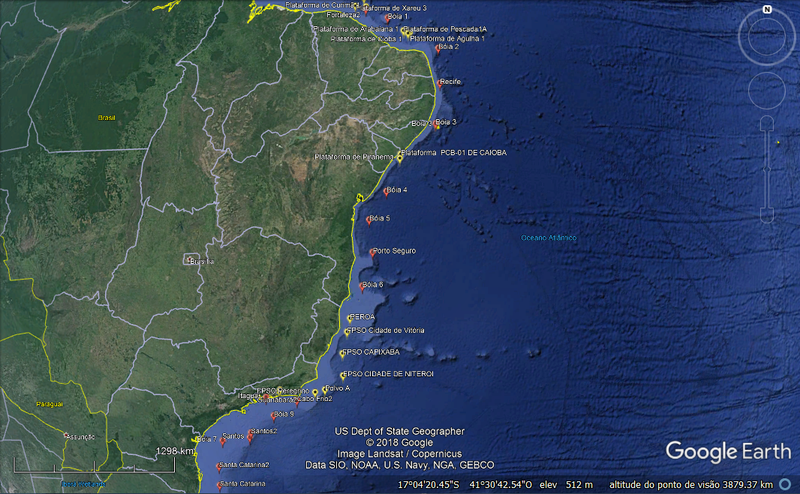
What inspired us to choose this project was the possibility of solving an old problem that surrounds navigation, the difficulty of access to the internet. Even with the emergence of satellite internet, it is still quite expensive for most of the public who need to use it. Developing a low cost quality internet transmission method seemed like an excellent business opportunity for us.
Our project proposes a new perspective on ocean internet use, receiving data via land links and distributing it using transmitters and receivers positioned on weather buoys and fixed oil stations, powered by photovoltaic plates and which form a giant internet sharing network on most of the Brazilian coast, serving low cost high speed internet up to 400 km off the coast.Our solution is effective in serving from small fishermen to large ocean liners as well as people in remote areas within the coverage area.
The main NASA feature we used in our project was EOSDIS Worldview, which we used to obtain various data about navigation.We intend to continue with the development and also we have as a future plan to expand the area of operation increasingly, to include as many coastal areas as possible and the largest possible area of the open sea, as well as the number of buoys, platforms and partner ships.
Although we did not develop the prototype during NASA Space Apps Maceió, we have previously researched equipment on the market to meet our need, as well as feasibility testing, applicability and technical functionality. We can then say with conviction that the execution of our idea is possible, with a moderate initial cost and a reasonable gain over time.
#internet, #low cost, #ocean #solar system, #satellite, #frequency.
https://www.google.com/url?sa=t&rct=j&q=&esrc=s&so...
https://www.shipmap.org/
https://www.nexojornal.com.br/expresso/2017/03/27/...
https://www.mercadolivre.com.br/
https://www.marinetraffic.com/en/ais/home/centerx:...
http://www.petrobras.com.br/pt/nossas-atividades/p...
http://www.anp.gov.br/dados-abertos-anp