
CruisHertz| Internet on the Ocean
Project Details
The Challenge | Internet on the Ocean
O-Web
O-Web aims at providing wifi connections in the oceans exploiting existing technologies
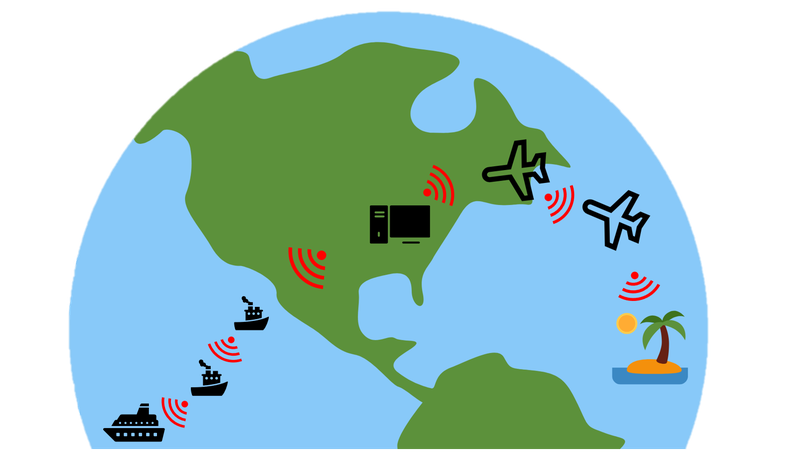
Oceanic intranet for internet using planes and ships as routers.
To address the problem of a poor or absent connection in the remote areas of the oceans, this solution proposes the use of airplanes and ships as mobile routers for the Internet signal. The service is named OWeb (Oceans Web).
Inspired by nature and especially by animals like whales, bats, dolphins, ants and many others that make a signal travel through very large distances by sensing and repeating it between the specimens, the proposed concept uses planes and ships that move all over the oceans to connect remote users with very far internet servers. This is made possible using low frequency microwaves typical of commercial Wi-Fi connections.
When a user in a remote area tries to access the Internet, his/her request is collected by the nearest routers mounted on a ship or on a plane that send it to an accessible similar devices on another ship or plane moving towards the servers on the mainland.
What we need:
- A system of antennae that can collect signals from the users and send it to the rest of the net of planes and ships is exploited. These antennae can be of standardised dimensions equal to those typically used for satellite TV, making cost reduction possible. The received signal gets simply elaborated and amplified to reach another knot of the net towards the targeted server.
- A software, that process and codes the signal from the user starting point, selects the best route to the needed server using an artificial neural network able to design a minimum distance path to the target. This is made using the information available from the GPS about the ships and the planes that are travelling in the interesting area. This process is needed to upload information to the Internet.
- The neural network works basing on the GPS position data of the ships and the planes that are travelling in the interested area. All the routers, the user and the server are located in a previously coded grid that covers all the Earth surface. Using this map discretisation, the neural network can compute the minimum distance path considering also signal quality, broadcast velocity and latency time. If the return signal from the server does not arrive in the expected latency time, the upload request is sent again searching a different working path to the target.
- If the signal gets to far locations with respect to the ones selected by the neural network, it gets stopped by the ship or the plane that receives it. This is needed to avoid the overcrowding of the router that is created by the signals that are diffused spherically, moving also towards ships/planes that are not in the optimal path to the targeted server.
- Downloading from the Internet is made using an easier process that resembles the one that is typically exploited in conventional ground connections with a distributed signal that comes from the server and reaches the end users.
Why OWeb:
- This solution is cheaper than the satellites based one, at the moment. The reduced cost is also granted due to the use of COTS (Commercial Off The Shelf) components.
- The maintenance of the software and the hardware needed can be performed with conventional, low cost procedures that result in reduced costs and in a reliable service.
- The service is thought for the internet coverage of remote maritime locations. However, the system can be used also to provide Internet connection also to isolated locations on land in a continuous and reliable way.
- The cooperation between ships and planes creates an intranet connection between them. This shall improve the situation awareness about the oceanic travels and routes leading to safer mobility and activities through and in the oceans.
Future developments:
- Oceanic buoys can be used to create a denser net of routers to increase the quality of the service and its coverage. These may offer fixed locations where routers can be surely found.
- A strong interaction with the satellites used for Internet connection to serve remote areas.
- Faster signals (up to 5GHz) and wider bandwidth.
Who uses OWeb:
- Commercial vessels like cargo ships, oil tankers, fishers.
- Scientific vessels
- Oil and other sea platforms
- Cruise ships
- Remote islands populations