
Internautas| Internet on the Ocean
Project Details
The Challenge | Internet on the Ocean
I-io Internet en el Oceano
Our challenge aims to solve connectivity problems in the Ocean, through the implementation of interconnected platforms to provide internet in the ocean, serving as a point of connection and access to navigators and scientists.
Internautas:
We decided to face the challenge of the Internet in the oceans, to provide low-cost internet access in remote places, and promote the inclusion of isolated communities
Draft
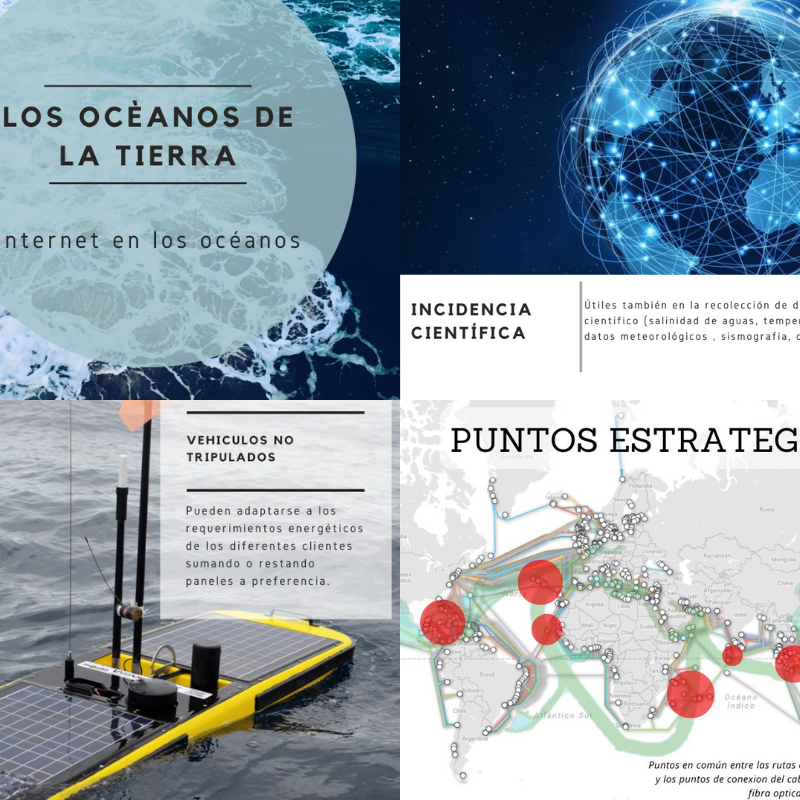
Through the use of existing floating platforms, which collect data of scientific interest, use them as repeaters of internet signals. These beacons are autonomous, they work through solar energy.
The plan
Create an I-io interconnection system, through the modification of vehicles such as the "Wave Glider", adapting them so that they can function as signal repeaters, and thus create a large wireless connection area in which vessels can access Internet or communicate with each other in a simple and simple way, at a very low cost.
Autonomous unmanned vehicle.
The Liquid Robotics GeoSURF Wave Glider has two main parts: a float, which contains all the sensors and communication units, and a subsurface wing shelf, which is connected to the float by a flexible 6 m long umbilical strap. Directional control is achieved with a rudder in the Glider secondary unit. The float is equipped with satellite communication systems (Iridium Satellite LLC) for remote data transmission, a GPS unit and a weather station. It also contains batteries that are recharged by a solar panel to provide power at night.
Connection points, ocean routes and fiber optics:
There are points of intersection between ocean routes and terminal emergencies of the fiber optic intercontinental underground wiring. Critical points which can be used as centrals to provide floating internet connectivity platforms, so that they can be distributed in mesh form over the ocean. Oil rigs, ground antennas, large vessels with satellite connection, and satellites would serve to provide internet connection to the I-io network. DTN and LoRaWan friendly: The platform system allows the implementation of the DTN protocol, each terminal will collect the data, and store it for transmission if and only if it can establish a secure connection between another terminal, thus preventing the loss of critical data. In turn, through communication LoRaWan would transmit information such as position, speed and address of the connected terminals, thus allowing to monitor and know the real-time status of all vessels in line, in addition to acting as an aid signal in case of any incident.