
TheBRIF-ingTeam| Internet on the Ocean
Project Details
The Challenge | Internet on the Ocean
OceanConn
A low-cost alternative to satellite connection, using simple and well known devices
OCEANCONN
"A link to reach them all"
In several remote areas of the world, such as oceans, Internet connection is still not easily available. This is a huge problem for those who work and live by the ocean.
OceanConn offers a low cost solution, alternative to the satellite connection.
How does it work?
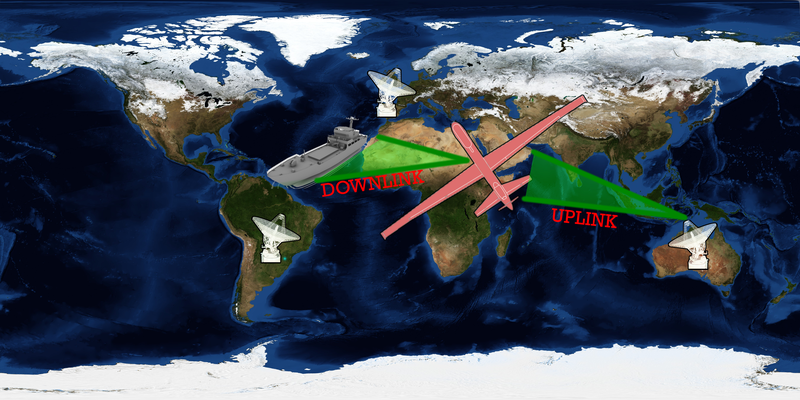
The system is composed by 4 or 5 interconnected air vehicles operating at medium altitude (15km), which overfly 24/7 the oceans (with periodic interchange for maintenence). They receive the signal from antennas located in strategical sites on the ground, run by NASA or third-part providers. The signal is spread in downlink to the ships, which are connected to one another forming a MESH network.
Our technology can adopt the DTN (Disruptive Tolerant Network) protocol. This will reduce the connection speed in favor of granted data transmission.
The UAVs (Unmanned Aerial Vehicle), which we are referring to, are existing prototypes such as Helios from NASA and Aquila from Facebook. Our idea is to bring out the best from these two in order to mold a flexible wireless network- called MANET.
Furthermore, the power supply is granted by high efficiency solar panels and batteries for the night flight. SWIFT, as NASA partner, developed a Ultra Long Endurance mechanism for those.
That strategy allows us to keep the costs low, exploiting already existing technologies (COTS).
For ship-to-ship communication we have used three Sector Panel Antennas, each with 120 degrees of beam. They can transmit at 10 Mbps when a little free portion of the not-licensed 900 MHz spectrum is used. (In case of small ships, it is convenient to install X-Bee or X-Tend modules which operate in the same way but with less speed and cost).
Instead, the vehicle-to-ship communication requires a parabolic antenna which operates in the P or L band without disturbing the radar communication.
If a satellite antenna is already on board it is reusable for our purpose.
Why NASA is interested in oceans?
Through OceanConn we propose developing a Distributed Oceanographic Match-up Service (DOMS) for the reconciliation of satellite and in situ datasets in support of NASA's Earth Science mission.
How do we do that? With a kit of sensors installed on the vehicle and the ships without affecting the costs for the users.
What we need to know about our world and our ecosystem ranges from the composition of the atmosphere to the surface temperature of the sea, but we are most interested in:
- Clouds
- Radiation budget
- Composition of the troposphere
- Wind speed and direction
- Sea temperature surface
- Ice temperature
- Distribution of water vapor
- Identification of ecological disasters such as oil spill
How is this solution adaptable to Earth's remote areas?
Our project could be implemented also for the ground based systems, satisfying the needs of remote internet users. The most important step to take is to localise correctly the antennas so the network will automatically work.
Engineering at service of humankind
OceanConn represents the chance to improve people’s personal life on the ocean, especially for those who have rare occasions to see their families.
Whether they are fishermen, researchers or sailors, they are people who constantly are in touch with one of the most delicate and precious ecosystem of our planet.
Daily most of them fight to protect the marine ecosystem, defending our costs from several kind of trafficking.
Using this technology they will have access to every kind of information useful for their activities and above all this, to support them in case of emergency.
Bibliography:
https://data.nasa.gov/dataset/A-Service-to-Match-S...
https://data.nasa.gov/dataset/Swift-Ultra-Long-End...
https://www.nasa.gov/content/dtn
https://en.wikipedia.org/wiki/Helios_Prototype
https://en.wikipedia.org/wiki/Facebook_Aquila
background image (globe) and antenna image from NASA website