
Project Details
The Challenge | Internet on the Ocean
Ship-To-Ship
Ship-To-Ship is a project to provide a connected ocean.
This is our Word used to save information
The Challenge is accepted, the proposal is made.
The term globalization has been widely spoken of lately, but because it is such a coveted word it is not quite a real word for our present time.
In our current reality, the internet itself is located in urban locations, but in rural areas it does not follow this model and are required to contract satellite internet services at a high cost and with very low quality.
In rural areas the satellite internet has not been popularized for several reasons. Among them is the price problem, which is exorbitant near the common Internet services.
Another major defect of this technology is that any object that passes in front of your antenna, or even when it will rain, you can no longer access the Internet. The operation of the Internet via satellite is similar to the common ADSL.
But instead of the data passing through a path full of cables, they are accessed faster, since the satellite has a direct connection to the antenna that the user has at home.
Communication for data transfer takes place from the client to the satellite and from this to the server. Human beings are each year becoming more dependent on Internet access, because it has brought US economic freedom among the continents. Nowadays it is no longer considered unusual something that you ask from China and arrive in your city in less than 14 days, with the Internet.
Everything, literally everything has become much more fast and communication becomes necessary at all points.
The Radiophone communications of the maritime mobile service can originate on land, being framed as Earth-maple, and on board, being framed as maple-earth.
The connections can be of short distance, being performed in VHF in the frequency range of 156 to 163MHZ, and long distance, being performed in HF, in the range of 4 to 22MHZ..
Plans for the customer:
Monthly Plan value: $100.00 to $350.00;
Annual Plan value: $1,000.00 to $6,478.80 per year;
Speed: 10mbs to 20mbs;
Installation Cost: $500.00
Atmospheric balloons
There are also designs like atmospheric balloons designed by renowned companies around the world like Google. GOOGLE's LOON project is based on balloons made of polyethylene that are transiting into the stratosphere at about 20 kilometers of altitude, where atmospheric winds are more stable.
They are protected in such a way as to resist extreme climatic conditions, such as a temperature of-50 º Celsius and an atmosphere without UV protection.
Each balloon covers an area of about 40 km in diameter and the signal is shared between them, so as to be in fact a free global network, with Wi-Fi at the speed of 3G networks.
To be able to use the Internet The project maintains a partnership with telecommunications companies that share the spectrum of the cellular network.
This way, people can access the Internet directly on their smartphones and other LTE-enabled devices, anywhere.
On the reverse path of communication, the balloons retransmit wireless traffic from mobile phones and other devices back to the global Internet, using high-speed links that operate in the ISM band of 5.8 GHz. But they can persist in the stratosphere Up to 100 days.
Our Project
Ship-to-Ship
Our Project is based on two concepts of the mesh network and P2P.
Shipmap.org
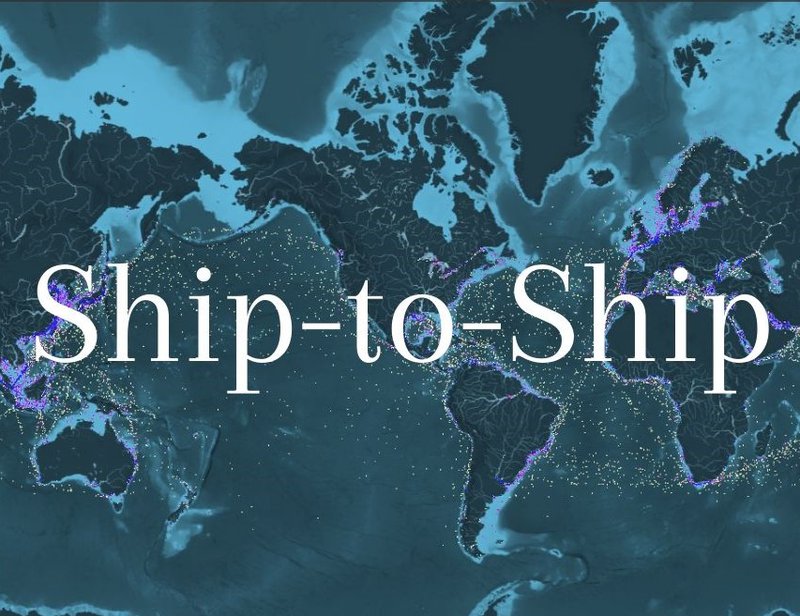
All of these points are ships doing comercial trips. Can you imagine to count all of these ships in the world? We tried too, but this number is not true.
Using the tecnology of the Mesh Network.
A mesh network is a network of interlocked routers called nodes, or points. These nodes work with one another to supply internet coverage over a broad area, something a traditional home network can’t provide.
How a Wi-Fi Mesh Network Works
You can think of a home mesh network as a chain of links. Each link (node of the mesh network) is connected to the others so that the whole chain (the network) can reach a far distance — much further than any one link (node) could reach — yet they’re still attached to each other regardless of how many there are.
So, to turn your standard Wi-Fi into a mesh network, you need a setup that includes more than one node. The way it works is by connecting the primary node to your modem like you would a regular router, and then connecting another node to the primary one.
From there, you can have a third or fourth node, or even more, connected to each other so that each node can communicate with other nearby nodes to provide Wi-Fi further and further away from the primary one where your modem resides.
Using this concept ot the connected homes, we can imagine in a ocean network.
With equipments designed to them.
Pros:
Targets any ship with strong Wi-Fi to solve Wi-Fi connection drops
Provides internet in areas that don’t have Ethernet connections or that are too far from the primary router
If a node quits working or is blocked by interference, the network will remain active so long as another nearby node is functioning
Everything operating within the local network can run smoother because the nodes can communicate with each other instead of having to communicate with the central router
Installation and management of most mesh networks is very easy because they are controlled with a companion mobile app
Extending the mesh network with more nodes is as easy as plugging the nodes into a power outlet and updating the app
Setup might cost less than a traditional network if you consider the ease of adding nodes and the fact that very little installation needs to take place (you don’t have to run any networking cables)
Most mesh network nodes are small and sleek, and don't have external antennas
What is P2P
Peer-to-peer (P2P) is a decentralized communications model in which each party has the same capabilities and either party can initiate a communication session. Unlike the client/server model, in which the client makes a service request and the server fulfills the request, the P2P network model allows each node to function as both a client and server.
How peer-to-peer networks work
Typically, when a user downloads a file, the user opens a web browser, visits the appropriate website and downloads the file. In this case, the website acts as a server and the user’s computer acts as a client that receives the data. This can be compared to a one-way street where the downloaded file is transferred from point A, the website, to point B, the user’s computer.
Why are peer-to-peer networks useful?
P2P networks have a few characteristics that make them useful:
They are difficult to take down. Even if you shut down one of the peers, the others continue to work and communicate. You have to close down all the peers for the network to stop working.
Peer-to-peer networks are extremely scalable. Adding new peers is easy as you do not need to do any central configuration on a central server.
When it comes to file-sharing, the larger a peer-to-peer network is, the faster it is. Having the same file stored on many of the peers in a P2P network means that when someone needs to download it, the file is downloaded from many locations simultaneously.
While P2P networking makes file sharing easy and convenient, is also has led to a lot of software piracy and illegal music downloads. Therefore, it is best to be on the safe side and only download software and music from legitimate websites.
Our Materials and Design
Our material is based in a Mesh router like this.
This model that our team will do is based on these 2 elements, a 37 centimeter galvanized pipe with 4 radio transmitter and receiver antenna, with a radius up to 400km.
The Costs Plan:
Analyzing in a real world, prices can vary. But in surveys we get to fixed costs:
The cost of the installation and the cost of the entire router.
In our surveys we arrived in a cost per router is $400.00
And the cost of the installation is like $25.00 because it is so usefull.
The prototype how was is it was made using the program named: Unity.
It is based to show people how our idea is based in a real world. In a playfull way.
