
Aztecs| Trash Cleanup
Project Details
Awards & Nominations
Aztecs has received the following awards and nominations. Way to go!
The Challenge | Trash Cleanup
TRASH CLEANUP
Our proposed machine will have necessary equipments to locate the garbage patches around the world (oceans) and clean the maximum amount of ocean garbage mainly constituting plastic debris or marine litter.
ABOUT US-
We are a research group from Chandigarh University working on a ocean project.Now we are looking forward to develop a machine known as 'OCEAN-US 1.0' , which will eventually help to reduce marine debris or oceanic litters.Basically we have a vision to develop 10 such kind of machines which will automatically work together .
Our team consists of five specialist member in 3-D designing,data analyst,electrical and electronics ,video editing and orator.
WE AIM TO CLEAN minimum 50 tons OF OCEANIC WASTE annually from our single machine considering all the climate activities.
1. Target Areas
Oceanic litters cause harm to marine life as well as human race.Our mission is to clean most of the plastic from the garbage patches. So, to tackle this issue our machine 'OCEAN-US 1.0' will help in cleaning the ocean garbage patches around the globe without harming the aquatic flora & fauna . So to get balanced life conditions we are focusing on how to clean this mess created by human only.
OUR SOLUTION:
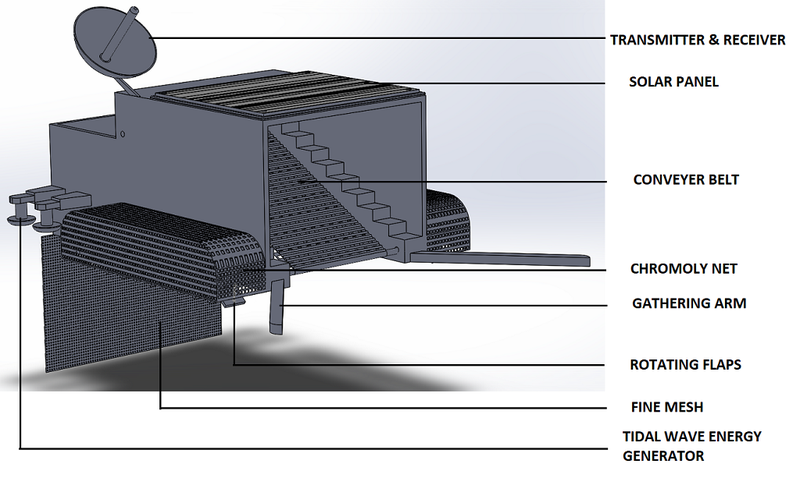
Our designed machine is capable of cleaning oceanic litters by using its advanced parts like solar panels,tidal wave energy generators, hydraulic pusher ,conveyor belt, communication radar,IR sensor to detect obstacles,level sensors and GPS. Our machine doesn't emit any carbon emission. It uses most of the natural resources like solar and tidal wave energies which will generate enough power for its continous working.
STEPS:
1. DETECTION OF GARBAGE PATCHES(REMOTE SENSING)
Our special feature includes a remote sensor which will use satellite live tracking system to navigate itself to that location where the garbage patch is located.
2. CONTROL BOARD
Our whole set of machines will be controlled by a control board sitting far from our where our machines are actually working. This will add autonomous feature to our mission.
3. EXTRACTION OF WASTE
Our machines consist of a conveyor belt which will collect the plastics/debris/litters from the ocean surface and dump those wastes into the sack placed in the garbage collector within the machine .
4. WHAT TO DO WITH THE GARBAGE COLLECTED BY MACHINE IN THE GARBAGE SACK ?
When our level sensor detects the limit of garbage sack it will automatically seal the sack and throw it in the ocean with the help of hydraulic pushers. The garbage sack will float with the machine attached by the string. When all the five garbage sacks in every machine are filled an extraction ship (which also runs on green energy) will collect all the garbage sack from every machine.
5. LEFT OVER MICRO PLASTIC
While extracting waste from ocean surface all the left over "Micro Plastic" will be collected by the mess which is placed beneath the machine. When the extraction ship will come all the micro plastic will also be collected with the garbage sacks.
6. WASTE TREATMENT
When all the waste is transported to the land it will be further recycled and the remoldable plastic will be used to create multiple products.
FUTURE SCOPES:-
1. We will integrate 'Artificial Intelligence' to our machine 'OCEAN-US 1.0'
2.We can also use the machine for cleaning up the 'RIVERS'
3.It can also be use to clean beaches by replacing the flaps with continous track belt which are used in military tanks.
RESOURCES:-
We have designed a ocean trash cleanup machine called 'OCEAN-US 1.0' using solid works.
We have taken the resources
https://oceanservice.noaa.gov/facts/marinedebris.html
https://en.wikipedia.org/wiki/Marine_debris