
Boring Cleaners| Trash Cleanup
Project Details
Awards & Nominations
Boring Cleaners has received the following awards and nominations. Way to go!
The Challenge | Trash Cleanup
Boring Cleaners
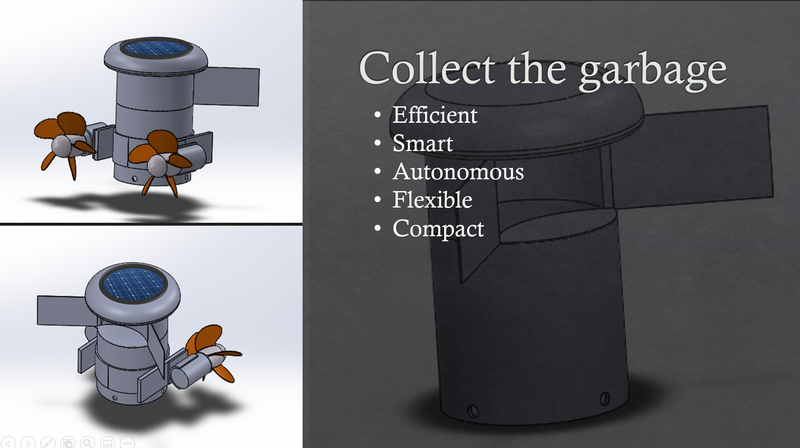
We aim to clean the oceans by being in the most impactful area and using flexible self-sustained collector robots.
Why did you build the project? What inspired your team to choose this challenge?
After analyzing the challenges presented by NASA, our team was excited about the impact that a great idea could have on the earth's ecosystem. Our team small in number was determined to help solve a big problem our society is facing.
How does your solution resolve the problems posed in this challenge? What problems and achievements did your team have? Share all the relevant details about your submission. Share failures as well as successes if they are interesting.
We decided to divide this mission into three phases:
- Finding the garbages
- Analyzing the area
- Collecting the garbages
In the first phase of finding the garbages, we started reading research papers that analyzed the topic of ocean garbages. After analyzing the research, we inspected NASA rich data-sets. These data-sets were used:
- location of buoys,
- water density
- wave heights
- UV
The location records of buoys are used to locate the garbage patches in the oceans. This technique was developed by NASA, and it is shown in the article name "Garbage Patch Visualization Experiment." Next, we have evaluated the water density data set because the rule of physics states that objects with lower density float on top of an object with higher density. Finding the best time when thewater densityis at its peak makes the collection more effective. Another factor we evaluated is water turbulence because it causes the garbages to get vertically redistributed in the water. One of the causes of water turbulence is waves; taking into consideration wave heights makes collection less challenging. A significant factor that plays a role in plastic degradation(causing micro-plastics) is also UV light, prioritizing zones with higher UV light, makes it more effective in regards cleaner, and less harmful environment.
In the second phase, when we arrive at the location, the system analyzes the area more in-depth by using drone images. After our system analyzes the area and locates the garbages, it defines the best routes the robots to use. The algorithm that we decided to use is the heuristic A* algorithm, as it is proven to provide the shortest best path.
In the third phase, the mother ships communicate with collector robots using wireless communication. The LoRa protocol is selected as it offers long-range and is low power consumption. The path that collector robots are going to take is provided using a the geological location system which is supported by the LoRa protocol. The collector robots generate renewable energy from the solar panel, kinetic, and potential energy to operate and to be able to collect the garbages.
With ultrasonic sounds and the combination of different frequencies, the robot ensures to preserve the ocean livings creatures from being collected. After each robot collects a pre-determined amount of garbages, it returns to the mother ship where the garbages are dispatched, and the mission continues in its loop until the area is fully cleaned.
In the end, the mother ship returns to the edge, and the garbages are processed for recycling purposes.
What NASA data and NASA resources are used in your solution?
From the NASA's data sets, the system uses
- The location of buoys, (real-time) accessed through - Global Drifter Program
- water density (real-time) (calculated from an average of water salinity and water temperature), accessed through - Global Drifter Program
- waves heights (real-time) ( Global Drifter Program )
- and UV emissions - accessed through id "AURA_UVI_CLIM_M
Article reference list:
[1] SOURCES, FATE AND EFFECTS OF MICROPLASTICS IN THE MARINE ENVIRONMENT: A GLOBAL ASSESSMENT ISSN: 1020-4873
[2] Plastic debris in the open ocean https://doi.org/10.1073/pnas.1314705111
[3] Popper, A. N., A. Hawkins (2012). The Effects of Noise on Aquatic Life. Springer-Verlag. Contain shorter chapters describing the most recent studies made on how fish respond to sound.
[4] GPS-free Geolocation using LoRa in Low-Power WANs
How can you improve your project, do you plan to work after space Apps 2019?
To improve this project, first, we are going to expand the team by hiring professionals in the corresponding areas. Our next step is creating a short term plan concerning our objectives for the first year. Partnership opportunities and collaborations with one or many international organizations whose aim is to decrease the number of garbages in the ocean are going to be prioritized.