
Project Details
Awards & Nominations
C-137 has received the following awards and nominations. Way to go!
The Challenge | Trash Cleanup
SpaceSea Method
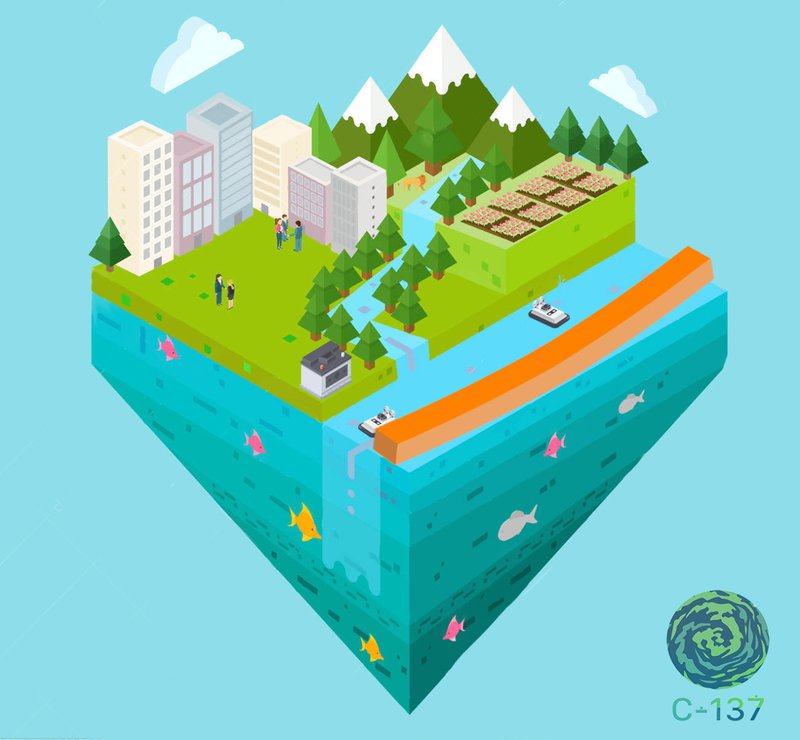
The SpaceSea method creates an intervention so that river waste does not reach the sea.
BACKGROUND
Our team choose this challenge to propose a solution to one of the biggest challenges of the world: Trash cleanup of sea. This challenge is not just about the quality of sea water, as well as the health of marine animals, the health of the population depends on water from polluted rivers supply, the quality of atmospheric air and even socio-economic issues related to beach tourism.
Ocean trash causes several problems in nature, such as the imbalance of water quality, risking the survival of aquatic animals beyond the life of marine algae and plankton, the largest producers of oxygen on the planet Earth. The removal and remediation of marine litter has a overall impact it's a major step in sustainability. Another advantage of the implementation of this system is the restoration of the economy and improvement in the quality of life of the places that because of pollution, has gradually reduced tourism and demand for housing in recent years.
According to the study presented at the World Economic Forum in one of its meetings in Davos, an estimate in 2050, the oceans will have more plastic than fish (by weight). The largest garbage at sea is plastic, that takes on average 450 years to decompose, if not start to prevent the waste is destined for ocean, sea amount of waste tends only to increase.
In the plastic decomposition processes, there is a division into microplastic (< 5 mm), present indirectly in fish feed, and therefore, in ours. Another study, this one by Conducted the Agency for Toxic Substances and Disease Registry (US Federal), points out the effects of microplastic in the human body, among them are: implications in development, hormone disruption, immune system, thyroid and various types of cancer.
Every year a large amount of trash reaches the oceans, around 25 million tons / year, and about 90% of trash comes from 10 rivers around the globe, you can see in the Picture below. For this reason, our project will act at causes of the problem, will be implement in locations where the most polluting rivers meet the sea, preventing the waste present in the rivers will be destined for the oceans.

Picture 1. Source: own authorship. (2019)
Among the ten rivers are eight from Asia: Yellow, Yangtze, Indus, Hai, Ganges, Amur, Zhujiang and Mekong, and two from Africa: Nilo and Níger.
WHAT IT DOES
Have been many proposed solutions to clean the oceans, but require a high investment value and often solve one problem by creating another. One of the solutions was created in 2013 by Boyan Slat, The Ocean Cleanup, is the use of a passive procedure that uses ocean forces to capture and concentrate plastic, in which case Both the plastic and the system are being by carried the wind, by the waves and the current. For this method to be effective at capturing plastics, the system must have a consistent difference between its speed and plastics.
For help us, in a recent article, we have access to the seasonality of river inputs regional plastic in the oceans, that is how much garbage flow from each continent lets its rivers to the sea in each period of the year, how is explaining in Image 2.

Picture 2. Source: https://www.nature.com/articles/ncomms15611. Acessed in October 20, 2019.
With the knoledge of the model developed by Boyan Slat and data about which rivers are the continent's largest river-to-ocean waste carriers, we decided to create a way where we refined Slat's idea by applying computational intelligence, with this we can to great efficiently and cost-efficient in the long benefit time.

Picture 3. Source: own authorship. (2019)

Picture 4. Source: own authorship. (2019)
The method SpaceSea consist to implement a floating barrier, which of its job of separating the solid waste from the water, after the accumulation of garbage in barriers. In certain periods, autonomous devices will be active. These barriers we improved with sensors, that analyze in real time the condition of the water, with this creating a useful database for researchers and publicly available through the mobile application, in addition to the installation of physical-chemical sensors to create the database, serve as environmental disaster alert when they detect large variation in water quality.
- BARRIER
Our method is to use floating barrier to accumulate the waste to surroundings thereof, thereby facilitating to collect this garbage. The most efficient method available for use floating barriers on the sea Ocean Cleanup System, cleaning is explained in figure 5, consisting of a fluctuant barrier incremented with a parachutes, creating a force balance system. This system, was created in 2013 by Boyan Slat is used by the organization Cleanup The Ocean, located in the Netherlands.

Picture 5. Source: own authorship (2019)
Our proposal with SpaceSea system is installed floating barriers similar to those used by Ocean Cleanup System, however that they are kept still in place where they are installed, also for floating it does not interfere in the activity of marine animals in water depth.
- ROBOTS / AUTOMATIC BOATS
The robots are responsible for removing trush of the water and move the temporary accumulation of waste sites, the first step in the correct disposal of waste found at sea. These robots can be activated periodically, or from sensors indicating stocking waste in the barrier, for the collection of garbage accumulated on the barriers.
Garbage collection boats with autonomous control, is justified by the difficulty and impossibility of collecting waste in more remote areas. The system executes and processes the actions of the collecting boat is composed of a PID control that is applied using control techniques or system that perform the operations continuously and accurately.
- SENSORS
Associated floating barriers will be Implemented physical-chemical sensors for water analysis before and after applying the method, in order to know the system efficiency, as well as creating a database to help future studies related to this issue. In addition to the sensors intended to the creation of the database, we intend to install other sensors that detect anomalies in sea water to prevent environmental disasters.
With these sensors is measured water temperature, because when waste have accumulates on the surface, can raise the water temperature. As well as sensors to detect strange events on the water, for example accidents involving oil outpouring close to barriers can be detected before the pollutant spread over larger areas. One possible oil dection sensor is Remote Optical Watcher, which by fluorescence techniques, measures the reflectivity of the water. In addition to this, with pH sensor would be possible to recognize other pollution accidents near the barrier.
In addition to the physical-chemical sensors, will be sensors applicator to control the movement and location of the robots. Regarding data collection sensors has been defined so that the information is of the highest quality, sensors for different types of applications are needed. Ultrasonic sensor, formed by a sender and a receiver this type of sensor detects objects at certain distances, sending small ultrasonic vibrations and receiving the reference signal on the object nearby. Gyro sensor, this device used to measure the angle changes of a moving object, being essential as a navigation instrument. Accelerometer, consists of capacitive plates measuring the variation of voltage between them, which when applied a movement on the sensor, generates an electric voltage by response, voltage is proportional to the generated movement, is a device used to measure the acceleration of object.
- APP / ONLINE PAGE
Data made available by the qualifications of the water by physical-chemical sensors, will be available in the mobile app and an online page where researchers can choose the location where want see information and graphs showing the efficiency of the system Space Sea. In it will be made available one of the robot's performance schedule.

Picture 6. Source: own authorship (2019)
The creation of the mobile application, for people who want to know the SpaceSea system and track important sea information obtained by physical-chemical sensors, was made by MIT App Inventor platform and can be accessed by the following link:
https://github.com/Nazarique/SpaceSea
We made a model of the online project page by website builder Wix, which will be for the database and other SpaceSea system information to researchers, you can see the online page with the following link:
https://thiagofellipea7x.wixsite.com/spacesea
NASA RESOURCES
To waste the study at sea, which places meant more waste into the sea and where they are, as well as the study of the different sea temperatures for the future creation of the database we use data found in the NASA Scientific Visualization Studio platform, the following links :
https://svs.gsfc.nasa.gov/4375
https://svs.gsfc.nasa.gov/3912
Future Plans
Our future goals are to improve this method of cleaning ocean by developing appropriate treatments for non-recyclable waste being discharged from the sea, as well as designing and implementing our system beyond solid waste such as oil spills and running the Space Sea system on the 10 most polluting rivers in the world.
TAGS
#Ocean #TrashCleanup #Technology
Sources
- [online] https://svs.gsfc.nasa.gov/4174 [visited on 10/19/2019]
- [online] https://pubs.acs.org/doi/10.1021/acs.est.7b02368 [visited on 10/19/2019]
- [online] https://theoceancleanup.com/ [visited on 10/20/2019]
- [online] https://www.nature.com/articles/ncomms15611 [visited on 10/20/2019]
- [online] https://www.ncbi.nlm.nih.gov/pmc/articles/PMC6132564/ [visited on 10/20/2019]
- [online] https://www.forbes.com/sites/niallmccarthy/2018/03/16/study-finds-microplastics-in-93-percent-of-bottled-water-infographic/#24d1514f73fa [visited on 10/19/2019]
- [online] https://books.google.com.br/books?hl=en&lr=&id=GWymw0PtH1MC&oi=fnd&pg=PR5&ots=5SqgibAvf_&sig=qMWjZaigdEq4wZkogQgnAfsc
- [online] Pfw&redir_esc=y#v=onepage&q&f=false [visited on 10/19/2019]
- [online] https://ourworldindata.org/plastic-pollution [visited on 10/19/2019]
- [online] https://hydrosheds.cr.usgs.gov/ [visited on 10/19/2019]
- [online] http://www.bluebird-electric.net/oceanography/Ocean_Plastic_International_Rescue/SeaVax_Ocean_Clean_Up_Robot_Drone_Ship_Sea_Vacuum.htm [visited on 10/19/2019]
- [online] https://epocanegocios.globo.com/Vida/noticia/2018/08/90-de-todo-o-lixo-plastico-nos-oceanos-vem-de-apenas-10-rios.html [visited on 10/19/2019]
- [online] http://www.libelium.com/smart-water-sensors-to-monitor-water-quality-in-rivers-lakes-and-the-sea/ [visited on 10/19/2019]
- [online] https://www.dreamstime.com/stock-illustration-city...[image creation]