
LIFO| Trash Cleanup
Project Details
The Challenge | Trash Cleanup
Oceanic garbage patches are collections of marine debris that come together due to ocean currents; they have devastating effects on ocean ecosystems. Your challenge is to design a mission to help clean up garbage from the ocean!
WasteCopter
Video could not be embeded.Watch Here
The artificial intelligence is able to recognise almost everything, but what about ocean garbage? Lets train AI playing "WasteCopter" and help us to save the Earth. (https://flowin.space/wastecopter/index.html?garbage-density=5)
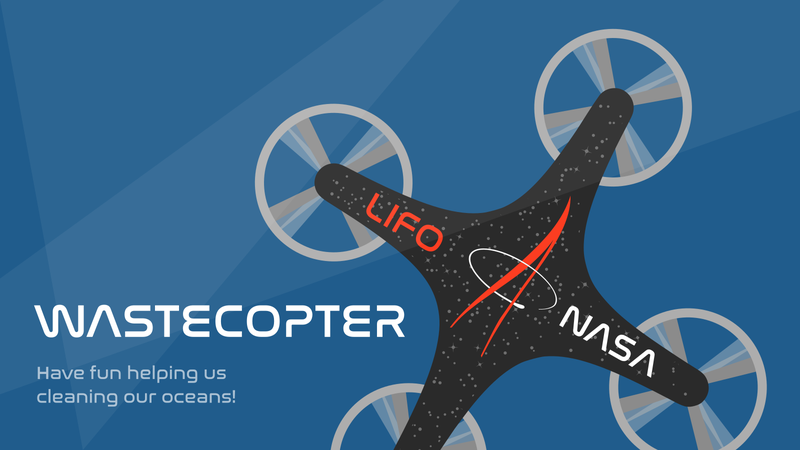
Starting from the problem of oceans pollution and the capabilities of Artificial Intelligence (AI), our team is willing to find an automatic solution for garbage collection in the oceans. The main issue is to automate the recognition of different categories of waste. Training an AI system with this purpose is not so easy since there not exist a floating waste database. Generating a new labeled database for garbage ocean recognition is very complicated and time consuming. Thus our idea is to create a game to involve the world community in the challenge to cleaning up a virtual ocean and, at the same time, to contribute at the creation of the first floating garbage ocean database.In the WasteCopter game, the user is placed in the middle of the ocean with a platform and a drone. The user can drive the drone to collect the waste which arise randomly from the water during time. There are 5 types of waste: paper, glass, metal, plastic and other. Once the drone catches the waste, the user has to recycle it in the right bin on the platform.The waste sprites are taken from the WEB and are realistic images. In order to make them more realistic for our purpose, we blended them in the background. Only a little part of the images are already labeled, wereas most of the other images are not labeled. So, when the user decides to recycle he is labeling our database.From "Garbage patch visualization experiment" NASA project (https://svs.gsfc.nasa.gov/4174) we inferred the amount of garbage to use for each scenarios (Pacific Ocean, Atlantic Ocean, etc). Meanwhile, from "EarthData" (https://search.earthdata.nasa.gov/search?m=-95.0625!-103.5!0!1!0!0%2C2&fsm0=Atmospheric%20Winds&fst0=Atmosphere&fsm1=Ocean%20Winds&fst1=Atmosphere), we took the information about ocean winds which are used to simulate better the game environment.