
Ocean savior| Trash Cleanup
Project Details
The Challenge | Trash Cleanup
Ocean Savior
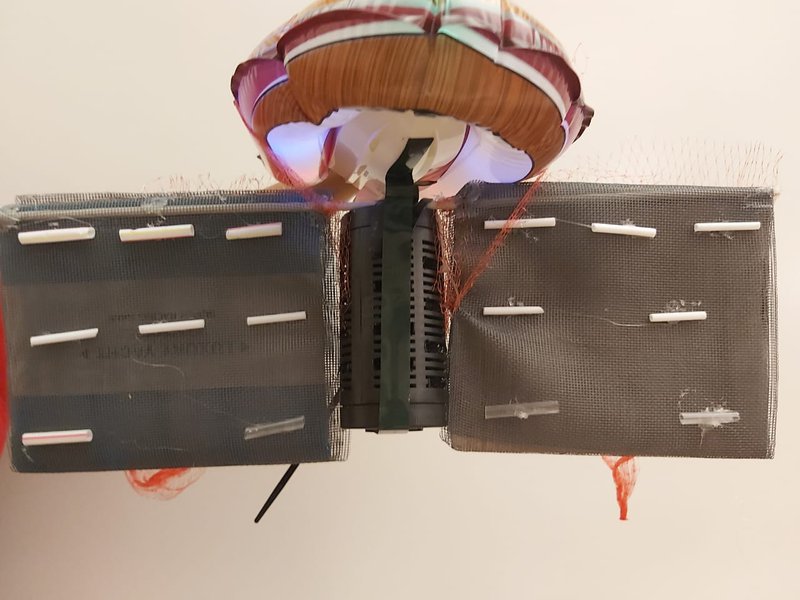
Our solution supposed to eradicate the ocean garbage problem by concentrateing on its two sides which is plastic and micro plastic.the idea in brief based on a thermal sensor,filter and a two wings attached to the ship from its two sides to collect plastic
Ocean savior
we are happy to be here with you and to introduce our solution to you.
First of all, our category is about earth's oceans and our challenge is ocean clean up. we choose this challenge specially because we saw that many of the sea creatures are in danger including humans
How affect the sea creatures and birds?
As plastics make them feel full when they are not so they starve to death. moreover, small creatures feed on them like lanternfish, and lanternfish is eaten by squids and squids are eaten by tuna and tuna is eaten by us. Because plastics don’t biodegrade which means they are destined to break down into smaller pieces after thousands of years called microplastics which might rotate in the sea eternally…..
we did lots of researches to get a scientific solution to save marine life until we discovered our solution and we wish that it helps our oceans.
at the beginning there are two problems that face us to save our oceans which are plastics and micro plastics. And simply our solution is collecting plastics and detecting micro plastics
Actually, the great pacific garbage patch is one of the most place in the oceans that consists of plastics and micro plastics. And simply our solution idea is: First We intend to use a thermal sensor supported with GPS to detect micro plastic which concentrate in "great pacific garbage patch" by selecting a limit where the ship will sail in a specific direction.
after that we put a filter that attracts and save micro plastic in the sponge inside it in addition to using the motor to stir the water.
Second: collecting plastic
We'll collect plastic using a wings in the two sides of the ship which consist of a constant net that attached to the ship from its two sides and a fixable moveable net attached to the previous net which will collect the plastic while the ship is moving.
Third: collecting micro plastics
Micro plastics are small fragments of plastic material, generally defined as smaller than what can be seen by the naked eye. Our increased reliance on plastics for countless applications has negative consequences to the environment. For example, the plastic manufacturing process is associated with air pollution, and volatile organic compounds released over the life of the plastic have deleterious health effects for humans. Plastic waste takes up significant space in landfills.
As the name implies, micro plastics are very small, generally too small to see although some scientists include pieces up to 5mm in diameter. They are of various types, including polyethylene (e.g., plastic bags, bottles), polystyrene (e.g., food containers), nylon, or PVC. These plastic items become degraded by heat, UV light, oxidation, mechanical action, and biodegradation by living organisms like bacteria. These processes yield increasingly small particles that eventually can be classified as micro plastics. Micro plastics On the Beach
It appears that the beach environment, with its abundant sunlight and very high temperatures at ground level, is where the degradation processes operate fastest. On the hot sand surface, plastic trash fades, becomes brittle, then cracks and breaks down. High tides and wind pick up the tiny plastic particles and eventually add them to the growing great garbage patches found in the oceans. Since beach pollution is a major contributor of micro plastic pollution.
more recent source of trash in the oceans is the tiny polyethylene spheres, or microbeads, increasingly found in many consumer products. These micro plastics do not come from the breakdown of larger pieces of plastic but instead are engineered additives to cosmetics and personal care products. They are most often used in skin care products and toothpaste and wash down drains, pass through water treatment plants, and end up in freshwater and marine environments.
Future map:
Our solution supposed to eradicate the problem of oceans trash in a wide range by solving the two sides of it. The first step of its success will start by embrace and funding it to apply the project perfectly. We have a lot of ideas to improve it such as:
Condition 1: if the area we are tending to clean up doesn’t have thermal sensor that work on GPS System so, dye Nile red will be used as an alternative to detect the micro plastics by giving them a Florescent color.
Condition 2: if they weren’t able to provide micro plastic filter then, a chemical compound non-toxic to the nature is used which is called ALUM (collects the micro plastic together when it dissolves in water)
Relating to our prototype whether all of the materials which we have presented are available
So by constructing a ship with a large scaled micro plastic filter attached at its bottom and two nets slightly are not curved will be stuck to both sides of the filter. behind these nets there are large bags that will collect the plastic that the two nets will try to pick them and they are affected by ocean currents so, plastics will be thrown backwards (in the same direction of the current)
In order to filter the oceanic water from both micro plastic and plastic. therefore, our nature will be cleaner, friendly to humans
These plastics in general will be contributed in recycling process and maybe in the near future plastics will be used in generating electricity or defeating plastics problems etc.…
To summarize what we had said we will get rid from the micro plastics by collecting it by the alum, attracting it by the net and filter them and at the end we wish to get rid from all things that make the oceans clean.