
Sea Guardians| Trash Cleanup
Project Details
Awards & Nominations
Sea Guardians has received the following awards and nominations. Way to go!

The Challenge | Trash Cleanup
Alfredi V1.0
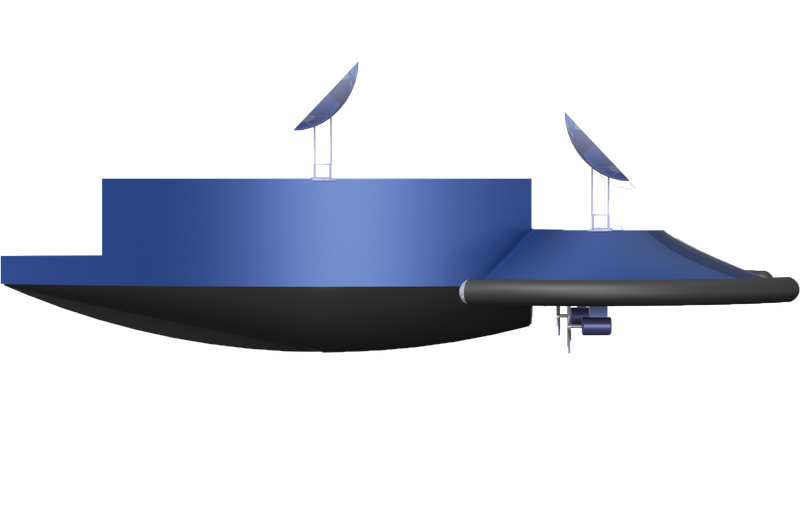
We have designed “Alfredi V1.0”, an unmanned boat aiming to make the ocean plastic-free by collecting the wastes to be recycled.
About 8 million metric tonnes of plastic waste is entering the ocean each year which is enough to cover the entire coastline on our planet. In the North Pacific, there is the so-called Great Garbage Patchbetween California and Hawaii. Events in the Indian Ocean in 2004 and Japan in 2011 injected enormous amounts of trash into the ocean. Similar, but less well-known patches occupy dynamically similar regions in the other oceans. In 2014, the ratio of plastic waste to marine life was 1:5 and by 2050 there will be more plastic than fish in the ocean!
Why?
- Plastic breaks down at sea into microplastics that are now part of the phytoplankton which is the base of the food web in the ocean. So, plastic is increasingly found in the stomachs of marine organisms. Oceans are the most important source of oxygen in the world as phytoplankton produce oxygen. Since increasing pollution in the oceans will adversely affect these organisms, this may have a profound effect for a global disaster in our World.
Who and What?
- In order to prevent such a catastrophe, we, as Sea Guardians, a team of 17 years old high-schoolers who want to be engineers and software developers in the future, have designed “Alfredi V1.0”, an unmanned boat aiming to make the ocean plastic-free by collecting the wastes to be recycled.
How?
- The boat will be made up of two parts: the first part is the collector, placed at the front acting as a gate to intake the wastes and the second is the carrier, located at the back acting as a separable shuttle to transport the wastes when it is full.
- The width of the collector is 12 meters, the space between the corners of the symmetrical wings is 6 meters and the opening of the collector is 2 meters. The length of the carrier is 15 meters, the width of the mid part is 5 meters and the width of the carrier’s gateway is 3 meters. The capacity of the carrier is 200 cubic meters.
- The skeleton will be made up of aliminium as it is light and durable and the covering of carbon fiber because it is highly inert to most environments and resistant to the sea water.
- The entire surface of our boat will be solar paneled, ultimately allowing it to run off solar energy, which will then be stored in the batteries to be used. These batteries will be placed into the wings and the back part of the carrier.
- There is a remote sensing system at the sides of the wings and with this system, any living objects nearing our boat will be identified since sun rays reflect, refract and absorb differently when interacting with each object and the electromagnetic wave obtained at the end creates a characteristic symbol.
- The collector consists of an antenna on the top which is used to send the coordinates of the device for a new carrier to come
- There are two inwards rotating gearwheels as a gateway of the collector which are continuously turning to take in the wastes on the surface of the ocean.
- The plastic wastes are entering the device through these gearwheels and directly going into the carrier.
- When the carrier is full of waste, the front cover closes and the carrier seperates from the collector. It will then travel directly to a certain gathering point by the Gps attached to it. In case of a power loss, there is a handle to be used by the ships to carry the device.
What if?
- This planet belongs to us and we all should know that there is only one planet which we can survive. With this device and our never ending enthusiasm for a cleaner and life-saving future, we have become the guardians of the oceans. Sea Guardians are the voice of the silence n the oceans!
Open-Source Data Resources obtained from NASA
•The Amount of Plastic in the Ocean
•Pacific GarbagePatch, Indian Ocean and etc.
•Phytoplankton
(https://earthobservatory.nasa.gov/blogs/fromthefield/2016/09/14/one-word/)
•Remote Sensing System
(https://earthobservatory.nasa.gov/features/RemoteSensing/remote_04.php)
•Carbon Fiber
(https://data.nasa.gov/dataset/Manufacturing-of-Nanocomposite-Carbon-Fibers-and-C/a725-pj25)