Project Details
The Challenge | From Curious Minds Come Helping Hands
HelpingHand
Analysis of flood risk areas, prevention and support
Motivation
We are a team of undergraduate student of Computer Science in University of São Paulo (also know as Universidade de São Paulo, or most know as "USP"), from the city of São Carlos in the state of São Paulo of Brazil. Our biggest dream is feel to developep something that will change others people life, especially the people who survives every dar as a war. Our idea come from the news [#1] of east zone of São Paulo (capital of São Paulo) of two days before the start of the event, the zone entered in a risk zone of being flooded. Since the news we have seen that we needed to create something that will change the life of these people, since the news was not reccent, we have watched on tv another incident like this happening, so it was time to do something about it, it was the time to give to these people some hope.

According to IBGE [#2] (Brazilian Institute of Gegraphy and Statitics, also know as "Instituto Brasileiro de Geografia e Estatísticas"), floods left more than one million of homeless people between 2008 to 2012 [#3].

The ONU has as the 13° objective to 2030 agenda [#4] take urgent actions to reforce the adaptability related to climate changes and natural disasters in all world. So we have put the same objective to develop our idea.
 In a research of World Resources Institute (also know as WRI) the most anually affected population in the world by floods was from 15 countrys of the world [#5], inclunding Brazil.
According the same institute the number of people affected by flodos may increase to 2.5 times more in 2030, caused by the climate changes.
Who
These are historys that will keep repeating more and more times if we do not do anything to help these people. We know an example of Maria that lost her house due to floods and don't have a place to live, João that lost his furniture and do not have money to buy others and Pedro who died overwhelm.
What
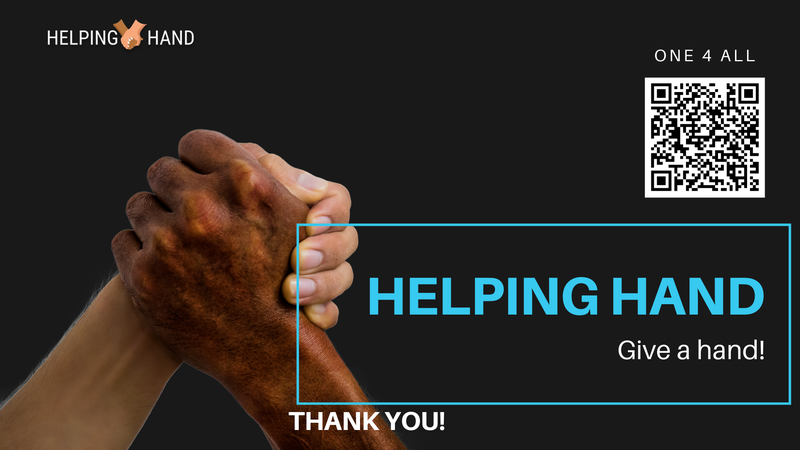
Our app called as "HelpingHand" that we are going to work with NGOs and local governament to create a free app that will map possible flood zones next to the user up to 4 days of advance. Even with existent apps with the same objective, they restrict to be a local app and not worldwide, since we pretend to reach all the world. So we pretend to start in Brazil and arrive to more countrys laters the launch.
The main app differential are the help feactures, take an example: the app can predict the flood a few days in advance, so you can move all your furniture to another local and still call help inside the app with the moving. This is an example that we call as "helping hand" and still we are impacting before the event, during and past the event. We are helping people, to live, to help, to equally and make the world a better place to live. Another example: if you are currently in a risk zone of flood, you can call the authorities immediately by clicking on a red button on the app called "S. O. S.". If you have experienced a flood situation you call a helping hand to give a shelter for a few days until you find a new place to live. Give a hand to the world!
How
We use the data of NASA Global Flood Monitoring System (also know as GFMS) treating them as algorithms called as DRIVE [#6], published in a paper called as "Real-time Global Flood Estimation using Satellite-based Precipitation and a Coupled Land Surface and Routing Model" made by enginners of nasa and the University of Maryland. The DRIVE perfoms flood forecast calculations throug data of satellities using latitute and longitude given to DRIVE.
Propertys of the algorithim:
- A circle radius of 7.45645 miles by pixel;
- He has a 3 hours sample;
- He detects based on retrospective 13 years of the satellities;
- Cover almost the entire world;
- Rate of 87% prediction success based on past events.
Beyond that data our project aims to utilize these data to every country to have a more trustable information, in case of Brazil, we add the data of the project called as "Cartas de Suscetibilidade a Movimentos Gravitacionais de Massa e Inundações" [#7] from the Brazilian Geological Service [#8] (also know as Serviço Geológico do Brasil, or most know as "CPRM"). So we can predict floods in certain regions and we can confirm the risk of flood using the local data.
In the maps below you can see how we can cross the data giving informations and verify the real ocorrunce of flood of floods that happened in the state of São Paulo.

Flood Prediction

Weather assessment of São Paulo

Risk of flooding in São Paulo
All data information was taken from 17/10.
Main applications features
- Map: informations of risk zones according to your location;
- Giving a hand: help someone in risk ou injured by checking the list of people and calling them by the given informations.
- Ask for help: tell your story and ask help to other people, share on the facebook to gain more engagement;
- S. O. S.: alert to button to cal authorities immediately.
To test our prototype on Figma, visit this link: https://www.figma.com/proto/ksGEWDczG5PBCRH1m8n7T8...
WHAT WE CAN EXPECT FROM THE FUTURE
According to forecasts, billions of dollars could be spent protecting people at risk of flooding. We expect a world where our data sampling can influence public and private organizations to build better infrastructure, invest in sustainable development and build solutions to minimize the effects of this problem.
In addition, our main wish is that many people are holding hands and helping each other in difficult times like this, minimizing the impacts of this kind of catastrophe.
We believe small actions produce big solutions! We believe that by holding hands we can build a better world!
References
- https://g1.globo.com/sp/sao-paulo/noticia/2019/10/18/chuva-deixa-parte-da-zona-leste-em-estado-de-atencao-para-alagamento.ghtml
- https://www.ibge.gov.br/
- https://censo2010.ibge.gov.br/noticias-censo.html?id=1&idnoticia=2628&view=noticia
- https://nacoesunidas.org/pos2015/agenda2030/
- On the page itself;
- http://flood.umd.edu/GFMS_wrr_Wu_etal.pdf and https://disasters.nasa.gov/instruments/gfms
- http://www.cprm.gov.br/publique/Gestao-Territorial/Prevencao-de-Desastres-Naturais/Cartas-de-Suscetibilidade-a-Movimentos-Gravitacionais-de-Massa-e-Inundacoes-5379.html
- https://geoportal.cprm.gov.br/portal/apps/webappviewer/index.html?id=a50bb1b7187149f19baca36458d9c9f7