
Sense To Safety (STS)| Smash your SDGs!
Project Details
The Challenge | Smash your SDGs!
Sense To Safety
Early wildfire alarms should be modernized and made globally available. Machine learning will improve detection & prediction and lower false alarm rate. UN's SDGs 3, 6, 8, 9, 11, 13, 15 and 17 are all affected by wildfires through 24 distinct indicators!
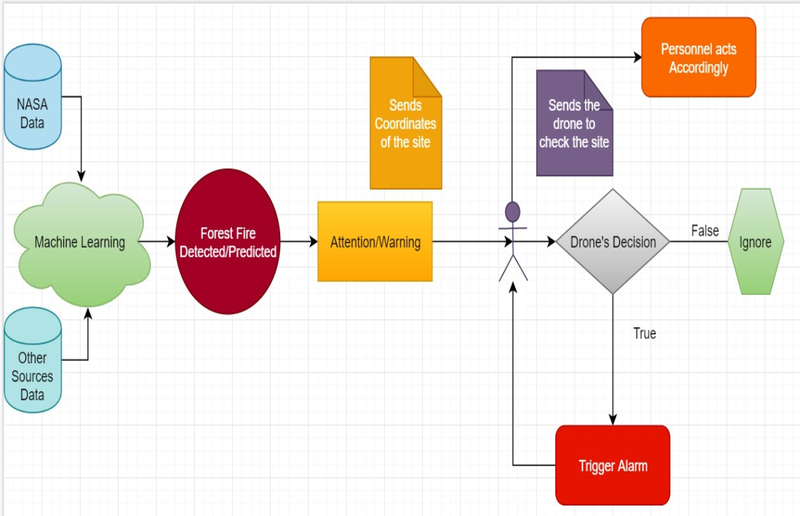
NASA and other Space organizations supply open satellite data to help detect and predict wildfires globally. Yet, disastrous events continue to happen all around the globe (2018 California Camp Fire, 2019 Brazil, Gangwon Province wildfire and Siberian wildfires, just to name a few). These can be observed quite clearly from many different databases and satellite data visualisations, even real-time. Yet links between Earth Observation based early warnings and actual fast responses are rarely mentioned in the scope of literature and news coverage we found during the NASA Space Apps event.
Wildfires are a sustainability issue in many ways:
- Large fires contribute to pollution in surrounding ecosystems and global air space
- Fires that spread to inhabited areas cause GDP losses through disruptions to services, lost resources and infrastructure
- Wildfires cause damage to biodiversity, natural resources and natural heritage
- Wildfires partially effect expenditure on countermeasures, amount of international technology cooperation and formulation of sustainable management practices
As such, within United Nations' Sustainable Development Goals the particular Goals and Targets that a global alarm service would help towards are:
- Goal 1: End poverty in all its forms everywhere
- Target 1.5: By 2030, build the resilience of the poor and those in vulnerable situations and reduce their exposure and vulnerability to climate-related extreme events and other economic, social and environmental shocks and disasters
- Goal 3: Ensure healthy lives and promote well-being for all at all ages
- Target 3.9: By 2030, substantially reduce the number of deaths and illnesses from hazardous chemicals and air, water and soil pollution and contamination
- Goal 6. Ensure availability and sustainable management of water and sanitation for all.
- Target 6.3: By 2030, improve water quality by reducing pollution, eliminating dumping and minimizing release of hazardous chemicals and materials, halving the proportion of untreated wastewater and substantially increasing recycling and safe reuse globally
- Goal 8. Promote sustained, inclusive and sustainable economic growth, full and productive employment and decent work for all
- Target 8.1: Sustain per capita economic growth in accordance with national circumstances and, in particular, at least 7 per cent gross domestic product growth per annum in the least developed countries
- Goal 9. Build resilient infrastructure, promote inclusive and sustainable industrialization and foster innovation
- Target 9.4: By 2030, upgrade infrastructure and retrofit industries to make them sustainable, with increased resource-use efficiency and greater adoption of clean and environmentally sound technologies and industrial processes, with all countries taking action in accordance with their respective capabilities
- Goal 11. Make cities and human settlements inclusive, safe, resilient and sustainable
- Target 11.4: Strengthen efforts to protect and safeguard the world's cultural and natural heritage
- Target 11.5: By 2030, significantly reduce the number of deaths and the number of people affected and substantially decrease the direct economic losses relative to global gross domestic product caused by disasters, including water-related disasters, with a focus on protecting the poor and people in vulnerable situations
- Target 11.6: By 2030, reduce the adverse per capita environmental impact of cities, including by paying special attention to air quality and municipal and other waste management
- Target 11.b: By 2020, substantially increase the number of cities and human settlements adopting and implementing integrated policies and plans towards inclusion, resource efficiency, mitigation and adaptation to climate change, resilience to disasters, and develop and implement, in line with the Sendai Framework for Disaster Risk Reduction 2015-2030, holistic disaster risk management at all levels
- Goal 13. Take urgent action to combat climate change and its impacts
- Target 13.1: Strengthen resilience and adaptive capacity to climate-related hazards and natural disasters in all countries
- Target 13.2: Integrate climate change measures into national policies, strategies and planning
- Goal 15. Protect, restore and promote sustainable use of terrestrial ecosystems, sustainably manage forests, combat desertification, and halt and reverse land degradation and halt biodiversity loss
- Target 15.1: By 2020, ensure the conservation, restoration and sustainable use of terrestrial and inland freshwater ecosystems and their services, in particular forests, wetlands, mountains and drylands, in line with obligations under international agreements
- Target 15.2: By 2020, promote the implementation of sustainable management of all types of forests, halt deforestation, restore degraded forests and substantially increase afforestation and reforestation globally
- Target 15.4: By 2030, ensure the conservation of mountain ecosystems, including their biodiversity, in order to enhance their capacity to provide benefits that are essential for sustainable development
- Target 15.5: Take urgent and significant action to reduce the degradation of natural habitats, halt the loss of biodiversity and, by 2020, protect and prevent the extinction of threatened species
- Target 15.9: By 2020, integrate ecosystem and biodiversity values into national and local planning, development processes, poverty reduction strategies and accounts
- Target 15.a: Mobilize and significantly increase financial resources from all sources to conserve and sustainably use biodiversity and ecosystems
- Target 15.b: Mobilize significant resources from all sources and at all levels to finance sustainable forest management and provide adequate incentives to developing countries to advance such management, including for conservation and reforestation
- Goal 17. Strengthen the means of implementation and revitalize the Global Partnership for Sustainable Development
- Target 17.6: Enhance North-South, South-South and triangular regional and international cooperation on and access to science, technology and innovation and enhance knowledge-sharing on mutually agreed terms, including through improved coordination among existing mechanisms, in particular at the United Nations level, and through a global technology facilitation mechanism
It is therefore of great interest to anyone working towards sustainable development to streamline Global Early Warning systems.
Our proposed solution carries the name Sense To Safety (STS), and it's motivation is in these few points:
- Satellite data is becoming increasingly more open, more real-time, and with better world-wide coverage
- Machine learning algorithms and platforms are a feasible solution to improve on detection and prediction accuracy and efficiency
- Global alarming system is feasible through internet access
Sense To Safety is an envisioned system combining these:
- Machine learning algorithm combines data from different sources meaningfully to make better predictions and improve detection algorithms. Some researcher groups have already made great progress on using ML-algorithms to this purpose.
- Automated alarms sent to national authorities and other subscriptors such as villages must be globally available instead of needing a large local organisation to interpret the data. Larger organizations may supplement the solution by using drones to confirm locations and warnings sent by STS.
Sense To Safety, as a concept, outshines many of the already running services at these areas:
- Variety and differentiation: Not everyone needs all information
- Subscribers may, in addition to their geographical location, choose between different levels of subscription: temporary or permanent.
- Decision-making is easier with less complexity presented.
- Unique: Global data used for a global solution
- Internet connectivity allows for communicating simple messages defining location and threat class.
- Different users have different needs, but an alarm is a universal concept. There is no need to have tens of overlapping systems, if there may be one analytically intensive enough.
- Diversification: Instead of separating predictions and detections to different systems, one system may infer both from large, frequently updating data, and thus cater to many needs.
A global system that is widely available would be in line with United Nations' principles, and thus, we predict that if adopted, STS or a similar system may be under one of the following parent organizations: UN-SPIDER, GFMC or GWIS. Improvement would thus be mainly incremental, as mapping and alerting systems already exist. They would be supported by ML-approach and the wide availability and simpler subscription model.
This type of solution could also be generalized to other disaster issues. The data exists. The global solution - not yet.