
UAI, ASAN| Smash your SDGs!
Project Details
Awards & Nominations
UAI, ASAN has received the following awards and nominations. Way to go!

The Challenge | Smash your SDGs!
Fabric Living
Solution that replaces brick with a membrane made of fabric that covers a structure that makes the construction of the house cheaper and more viable.
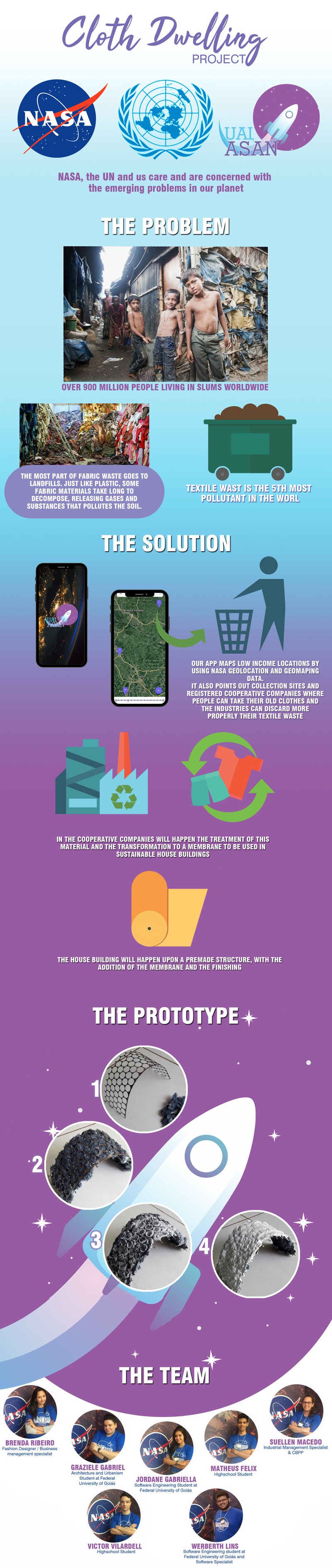
NASA, the UN and us care and are concerned on leading a righteous quality of life to people, and these people are you!
The UN estabilished sustainable development goals, and one of these emerging problems is the dignified housing for the low income population.
We've developed an app in which we use data and images given by the NASA satellites, to map the low income areas and monitor the evolution of housing increase in these areas.
But only to monitor the housing increase seemed too little of a challenge for us.
Think with me: what do you do when you don't want anymore a determinate piece of clothing?
Probably many of us will donate those pieces, but what happens with those pieces when they can not be used anymore?
The textile industry is among the five biggest pollutents in the world. Only on Brazil, this industry generates about 175 thousand tons of textile waste every year.
But now you might wonder, what does fabric have to do with housing?
Our sollution, alongside our app, is to substitute the bricks used on a construction site for a membrane made of fabric and plastic resin, that covers an structure and makes the building of a house cheaper and more viable.
How do we do that fabric membrane? First, we will provide collection sites in places with high traffic of people, like shoppings and gas stations, to pick up unused clothes and fabrics that usually go to the trash bin. Then, cooperative companies will receive the fabrics coming from the collection sites, and also directly from the industry that produces textile waste. With all that textile waste collected, they will be treated (cleaned, washing out any filth), crushed, mixed with a fibrous plastic resin, then compacted.
This membrane will be the covering of a structure, and then it can be used spackling to cover it, for aesthetics.
Our idea was inspired on the construction process that the Architect Zara Hadid uses to build her architectural art and housing.
Besides being sustainable, our solution reduces the costs of a common covering used in brickworks. In Brazil, the cost of brickworking is around R$ 384.00 per m², while using the fabric membrane, this cost is reduced to R$30.00.
REFERENCES
Information about the SDGs:
http://www.agenda2030.org.br/ods/11/
Information about unsafe and unhealthy housing:
https://super.abril.com.br/mundo-estranho/qual-e-a-maior-favela-do-mundo/
Solution Inspiration:
Textile Industry Data and Study on Waste Recycling in Brazil:
Master Thesis on Textile Waste Recycling: https://www.teses.usp.br/teses/disponiveis/100/100136/tde-26042016-192347/publico/CorrigidaWeltonZonatti.pdf
Environmental impacts of the Textile Industry in Brazil:
https://www.abit.org.br/noticias/brandili-da-exemplo-no-reaproveitamento-de-residuos-texteis
NASA data used:
NASA Open Earth Imagery API:
https://api.nasa.gov/planetary/earth/imagery/
Google Earth Engine: