
Project Details
Awards & Nominations
Galileo has received the following awards and nominations. Way to go!

The Challenge | Eeny, Meeny, Miney, Sample!
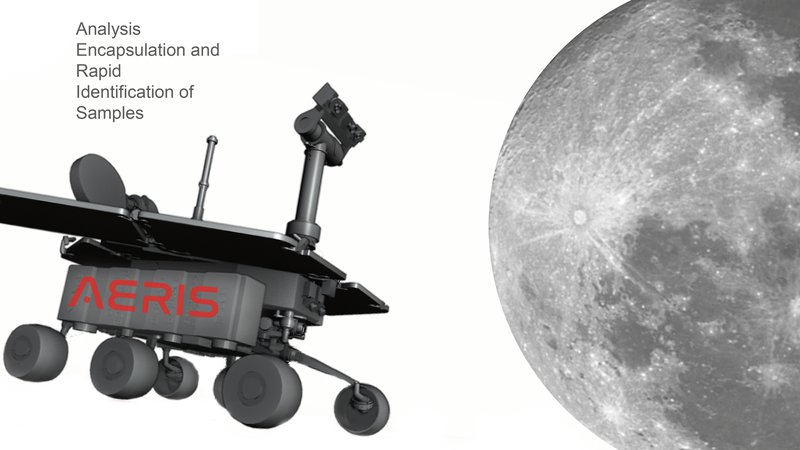
AERIS System: Analysis, Encapsulation and Rapid Identification of Samples
AERIS is the most efficient system to identificate, characterize and value lunar samples in-situ to establish a survey area, analyze data in real time and only collect those samples with the highest value.

ABOUT US!

CURRENT SITUATION
- One of the tasks in astronaut missions on moon surface is to collect rock samples in order to identify and analize them on Earth. This task represents physical and scientific hard work, and to get the samples with the highest value is a challenge.
MISSION OBJECTIVE
- Create the most efficient system to identify, characterize and value lunar samples in-situ to establish a survey area, analyze data in real time and only collect those samples with the highest value.
MISSION ENVIRONMENT
- AERIS System will be developed in one of the most challenging environments known by humans: Space. With extreme thermal range, high levels of radiation, microgravity and no pressure we proposed AERIS. We reduce astronaut exposure to these extreme conditions and save time and mission costs.
INSPIRATION
- Since Apollo program, humanity tried to push science frontiers. To keep reaching new boundaries we need to learn about the past, so we can know about the future. With limited resources and extreme conditions we need to optimize the collection of rocks and soil on the surface on the moon. Bearing in mind those aspects, AERIS aims to obtain through multiple stages of the project using the concept of EFFICIENCY, the unknown data and the remaining information that is waiting to be discovered.
ARCHITECTURE AND DESIGN
Analysis, Encapsulation and Rapid Identification of Samples (AERIS System) Link to Video

- 2D-XRF and 3D-Raman surface analysis for Elemental and Molecular identification on the sample. XRF is one of the most accurate and economic elemental analytical methods (non-destructive and non-invasive), and Raman imaging is a powerful technique for generating detailed chemical images based on a sample’s Raman spectrum. [5-7].
- Polymeric encapsulation (PMMA or PDMS) for sample preservation.
- RFID label printing for identification and topographic sample display [8].
With the XRF and Raman data, the weighting metric shall be calculated. Then, with the topographic location data and the identification of the RFID Tag, a visualization map of the samples will be created. With this map, the next sample collection mission will be programmed.
Finally, the AERIS system was controlled with a Multiplo control board (Arduino compatible) and the code is found in this LINKMISSION STAGES:
STAGE 1 - BEST LANDING PLACES EVALUATION
Best landing sites are pre-selected analysing orbital data.
In the first stage, previous data collected over 60 years of space exploration was used. From geophysical data (gravity and magnetometry), geochemical and spectrometry measurements to moon probe data, we estimate the best landing zones in order to make more accurate the rover mission.
STAGE 2 - AERIS (Analysis, Encapsulation and Rapid Identification of Samples)

ANALYSIS:
2D-XRF and 3D-Raman surface analysis for Elemental and Molecular identification on the sample.
- 2D-XRF
In the first AERIS module, an 2D-XRF technique is used [5]. XRF is one of the most accurate and economic elemental analytical methods (nondestructive and noninvasive), also measure a wide range of atomic elements. Mission Chandrayaan-2 (ISRO-2019), use Large Area Soft X-ray Spectrometer making use of XRF spectra to determine the elemental composition of the lunar surface)
- 3D-RAMAN
Confocal 3D-Raman [6-7] imaging is a powerful technique for generating detailed chemical images based on a sample’s Raman spectrum. This technique is a non-destructive chemical analysis which provides detailed information about chemical structure, phase and polymorphy, crystallinity and molecular interactions. It is based upon the interaction of light with the chemical bonds within a material. As an advantage Raman imaging is take with a practical handheld instrument.
- FOSSIL BACTERIA IDENTIFICATION BY VISUAL RECOGNITION
Bacteria fossil recognition is made by Visual Recognition from GOOGLE AI (code) [10], where we identificated and matched samples according to fossil bacteria material databases.

- WEIGHT AND SIZE ESTIMATION OF EACH SAMPLE
Using the data provided by telemetry, the 3D scanner, together with the data obtained previously by XRF and RAMAN analysis, the density of the sample can be estimated and finally the weight and volumetric size can be easily obtained.
RAPID TOPOGRAPHIC IDENTIFICATION OF SAMPLES:
- This stage includes lunar steering stage and an evaluation system (MOON POINTS) to characterize and classify the samples with our database from earth, this process allow us to desestimate rocks with low scientific or economic value.
STAGE 3 - LUNAR STEERING
- Lunar steering is based in Real Time Processing (Auto A.I for data processing and modeling). All the information is sent in real time from the rover through a satellite system to a control center base down in earth with a delay of approximately 8 minutes due to the big distances.
The information obtained is correlated with a database and the desirable parameters we are searching for. An assignment is made for each rock sample with our moon point scoring system, that quantifies the value of the rock.
STAGE 4 - VALUATION SYSTEM FOR SAMPLES (0-100) "MOON POINTS"
- A valuation system has been created in order to give each sample a value, and to create a map with the highest metric values for future sample collection. It will give ‘Moon Points’’ to each sample between 0 to 100. The metric was defined in 4 parameters: Scientific Value, Economic Value, dimension and weight of the sample. For Scientific Value, it is considered the finding of water or Fossil Bacteria [3-4]. The Economic Value is defined considering the abundance of rare elements, phosphates, heavy metals and potential rocket fuel (specially helium-3 isotope). Besides, we consider the amount of samples that can be transported back to Earth with reasonable weight and dimensions.

STAGE 5 - ENCAPSULATION:
- If the sample received a high value from the valuation system, a polymer encapsulation technique is used to prevent future degradation and preserve the scientific value of the sample (video). After encapsulation, an RFID tag is printed with an electronic ink film[8] (made with adequate metal nanoparticles), and is followed by a subsequent conformation by a Laser direct-writing (LDW) technique [9] (video). Those RFID tags are cheap and have an range of measurement up to 60 meters with an identification device. The tag allows the machine to encode and characterize the sample with our moon scoring system (moon points) for future recollection missions.
PROBLEM DEFINITION
Two main backgrounds were defined:
The first one is about the limited resources:
- TIME TO COLLECT SAMPLES
- DIMENSION OF TRANSPORTED SAMPLES
- WEIGHT OF THE MATERIAL
- TIME LOST IDENTIFYING VALUABLE SAMPLES
The second part of the challenge is defining the valuation criteria for lunar samples. Keeping in mind that astronauts in previous missions brought 800 pounds of samples without being able to estimate which sample had the highest scientific value. We create a valuate system (MOON POINTS) where we choose based in a metric equation the most important parameters for a sample of interest. The highest Moon pointed samples, will be tagged with an RFID technique based on electronic ink in order to get an efficient recognizing and collecting system for the astronauts and future missions for further studies on earth.

FUTURE PLANS
- With the continuation of space missions and the future missions to the moon, mars and beyond. Galileo Team is looking forward to upgrade the AERIS system, improving aspects such as, Increase the speed of the rover, amplify the size range to identify samples, development of identification systems to rock prospecting, drilling and extraction. Finally, Including new technologies that let us keep improving our identification system.
GALILEO TEAM
Hernan M. R. Giannetta: PhD in Robotic Engineering. Currently working as a Postdoctoral researcher at the National Technological University (UTN-BA), in Buenos Aires, Argentina. My current research interests are NanoRobots and microsystems.
Federico Gregorio Agostinelli: Geology student at University of Buenos Aires (UBA) and Musician. I am part of the management committee of Gemipa, an association of mineral collectors in Argentina. I also make scientific divulgation at the University of Buenos Aires.
Angela Rodríguez Ramos: Geology student at Buenos Aires University, Business management degree. Currently working in mars crater characterization project and interesting in Energy innovation.
Nuncio Joaquín Palermo: Geology student at Buenos Aires University, Member of the AAPG. Member of SEPM.
Ramiro Román: Data Scientist and Editor at University of Buenos Aires (UBA)#BigData Fan. Co-founder of TREZA, focused on generating new technological solutions with artificial intelligence and Machine Learning.
Alejandro Fairbairn: Chemical Engineering student at La Plata National University (UNLP). Interested in the Energy Transition and Sustainability.
Gala Fiasche: Fashion Designer at Buenos Aires University. Interested in Sustainable Design and worried about the future of fashion industry.
RESOURCES
- [1] NASA-Home 3D Resources . https://sservi.nasa.gov/
- [2] SSERVI , https://sservi.nasa.gov/
- [3] Bacterial Database: https://ucmp.berkeley.edu/bacteria/bacteriafr.html
- [4] Westall, F. ( 1999), The nature of fossil bacteria: A guide to the search for extraterrestrial life, J. Geophys. Res., 104( E7), 16437– 16451, doi:10.1029/1998JE900051.
- [5] P. Sarrazin et al, MapX: 2D XRF for Planetary Exploration - Image Formation and Optic Characterization, 2018 JINST 13 C04023 doi: https://doi.org/10.1088/1748-0221/13/04/C04023
- [6] C. Kallepitis et al, Quantitative volumetric Raman imaging of three dimensional cell cultures, Nature Communications, 14843, 8, 1, 2041-1723 https://doi.org/10.1038/ncomms14843
- [7] 3D-Raman, https://www.witec.de/assets/Literature/Files/WITec...
- [8] Herrojo, C.; Moras, M.; Paredes, F.; Núñez, A.; Ramon, E.; Mata-Contreras, J.; Martín, F. Very Low-Cost 80-Bit Chipless-RFID Tags Inkjet Printed on Ordinary Paper. Technologies 2018, 6, 52. https://doi.org/10.3390/technologies6020052
- [9] Sílvia Manuela Ferreira Cruz, Luís A. Rocha and Júlio C. Viana (July 25th 2018). Printing Technologies on Flexible Substrates for Printed Electronics, Flexible Electronics, Simas Rackauskas, IntechOpen, DOI: 10.5772/intechopen.76161. Available from: https://www.intechopen.com/books/flexible-electron...
- [10] Visual recognition, Google AI .https://cloud.google.com/vision/docs/?_ga=2.174517...
SPECIAL THANKS TO
Dr. Mauro Spagnolo and Dr. Sonia Quenardelle from the Buenos Aires University (UBA) for the provision of meteorite and basalt samples for further analysis. We also wish to thank Dr. E. Di Liscia and Dr. E. Halac from the Commission of Atomic Energy (CNEA-CAC), for the Raman measurements made on the samples, also thanks to B. Villa of the Argentina Foundation Nanotechnology (FAN), for the XRF measurements performed on the samples.
For the video production thanks to Micaela Gonzalez and Cristian Castillo, mulltimedia editors and designers from Da Vinci Institute, also thanks to Florencia Gimenez (broadcaster), Guillermo Rivanegra (Music teacher), Diego Nuñez y Alejandro Martinez Casas (Da Vinci Insitute Director) for all the support.
Finally, the hardware used in this project has been partially supported by the National Technological University (UTN.BA), and by the company Treza (treza.com.ar).
