
Lunar Surgeon| Eeny, Meeny, Miney, Sample!
Project Details
The Challenge | Eeny, Meeny, Miney, Sample!
Lunar Surgeon
We are using an advanced autonomous algorithm to help the rover to navigate through the lunar surface. During the navigation process the lunar rover will find the appropriate place for conducting the soil sample collection process using the lunar surface.
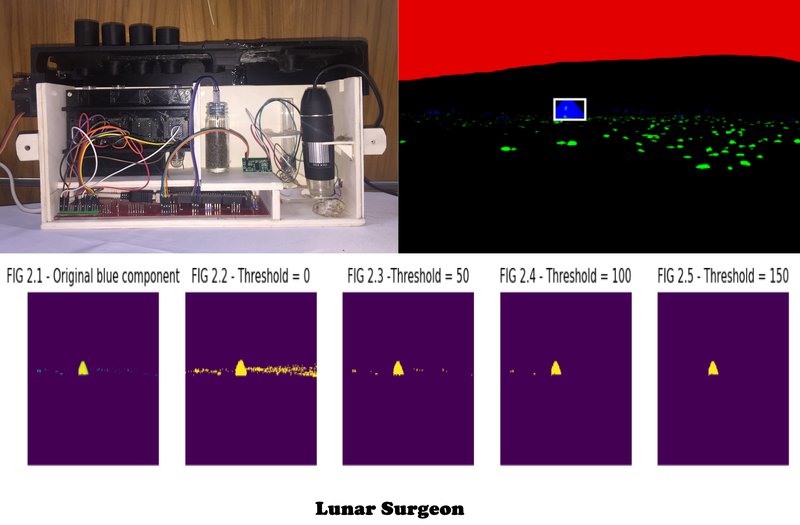
BACKGROUND:
We are providing a complete solution to enrich the existing lunar data in NASA’s open data portal. Around 3-4 billion years ago huge explosions occurred by the asteroids which helped to exchange a lot of materials of outer surface between our home planet and the Moon. As the atmosphere of the Moon is vacuum and there is no active biology, the rocks of the early stages of the earth bought by the explosion are almost unchanged. So, if we are able to collect those rocks we can learn what was the earth like around 3-4 billion years ago. But even after countless lunar missions we are unable to find enough of these rocks. So, after conducting a research on past lunar missions we came up with a unique solution. Our proposed solution have both software and hardware prototypes. For autonomous traversal in the lunar soil we are using customized machine learning and computer vision algorithms to analyze the lunar environment and find the proper place to conduct further experiments. We are using thousands of lunar landscape images of NASA’s lunar data repository from NASA open data portal. After reaching the designated place it will scan the surrounding rocks and soils.The rock and geological archive will help to determine whether these soils are present in the latest data repository with the help of custom AI algorithms. It will match each and every rock sample with the existing database in real time. If it can find what it is looking for the lunar rover will go to the next step in the analysis process the “Science experiment”. For this we are building the second version of our science unit prototype. The first version has already been tested in the MDRS(Mars Desert Research Station) successfully. This unit consists of almost six different soil experiment units : Nitrogen, Phosphorus, Potassium, Amino acid, Biomass, Water capillary .We also have separate unit consisting of all kinds of gas sensors to detect air samples. If the result is positive the onboard system will automatically collect necessary amount of needed samples and store it in a vacuum chamber to bring it back to the earth.This will solve the drawbacks of existing sample collection process and will save time and cost.We need to understand our neighbour first to reveal many mysteries not just outside our home planet but also of our planet too.
BENEFIT:
- Maximum amount of unknown samples in a single mission.
- Reducing the time and cost.
- Enriching lunar data repository in real time.
- Less human monitoring .
- Best use of huge NASA repository.
SYSTEM DESIGN:
Software:
Dataset:
We explored NASA dataset collections to get Images of moon surface and different elements of the moon to know our neighbours better. We found a lot of resources but some were scattered or in different formats like pdf. So, we created our own dataset by merging some of them to create a dataset where in one place we get all the images of the moon. For now we have around 1276 pictures of Basalt and Breccia rocks and we are constantly updating the dataset and training our model which is currently trained on 1276 photos of Breccia and Basalt.

Image Processing:
You only look once (YOLO) is a system for detecting object on pre-trained(COCO) dataset or custom dataset. Since from different sources and missions of NASA we collected our dataset so we trained our dataset using the data and we pledge to train it on all the elements that were found on the lunar surface so our model can recognize anything known and unknown on the lunar surface. To implement YOLO we forked the darkflow repository along with open CV and Tensorflow. It detects known sample and the one he can't find in his labels shows as not in database and shows it as most interested area. Continuous update of this model lets us find new undiscovered shades of the moon.
Hardware:
The hardware partis used to collect information of unknown samples. When our module detects any new rock or sample site, the on board module obtains information of its physical, chemical & biological properties of soil and add that in library.After collecting sample the whole examination process is done automatically. We are using chemical & spectroscopic methods for sample analyzing. Our whole system is air tied and contamination free. Moreover, the system goes under sterilization process before each operation. The tests are Biomass test, Amino Acid test colorimetric spectroscopic and Water Flow Capillary test.

In Biomass test the weight variation is being detected before and after the heating process .The formula is: Biomass = (difference of weight/previous weight) x 100. Which measures the percentage of biomolecule such as carbon, nitrogen and other organic compound. Combination of HX711, a 24 bit analog-to-digital converter and bridge sensor helps to detect even a slight change of weight.
In Amino Acid test, we have used ninhydrin reagent to detect the presence of amino acid (both α & β) in the sample.


The water capillary test calculates the water absorption capability of that sample using sensor embedded container and E-tape liquid level sensor. This test indicates whether the soil of the lunar surface is able to hold the water in ground.
A sample collecting chamber is also incorporated to store pure form of sample to bring back home.
The Spectroscopy test, which focuses on quantitative analysis of samples using colorimetric spectroscopic method combining four programmable color light to frequency converter. Thus us to detect chemical properties and intensity of the compound in that sample. Our system can successfully detect the intensity of Nitrogen, potassium, phosphorus & pH of any soil which are necessary elements to sustain biological life. We are also trying to use AS7265X- an eighteen channel VIS to NIR optical inspection sensor.


A custom Raman spectrophotometer is under development which can perform physical and structural analysis of soil by generating graphical data representation.
 (Potassium test)
 (Phosphorus test)
 (Nitrogen test)
After that the microscopy of rock & soil composition test miniature microscope zooming capability of up to 500x and provides the information of soil composition that indicates the types of soil.


There is one central soil distribution system which can distribute desired amount of soil in each experiment unit. The soil distribution system will be activated few second after the sensor detects he desired amount of soil presence in the collection container allocated for each experiment unit.
We have compared all our on board tests’ results with Laboratory value. Which helped us to avoid error and increase efficiency of each tests. During the whole procedure no hazardous chemicals are used and maintaining safety guide lines & all possible precautions have taken.

FUTURE PLAN:
- Make a complete prototype
- Test our prototype in a space simulated environment.
- Analysis the test results from hundreds of tests and make a better algorithm and full custom hardware.
Github Link: https://github.com/Razin1996/Lunar-Surgeon
Reference:
Amino acids in lunar (https://science.gsfc.nasa.gov/sed/content/uploadFiles/publication_files/Elsila2016.pdf)
Biomass calculation( http://www.fao.org/3/w4095e/w4095e06.htm).
Soil nutrient analysis( https://www.jove.com/science-education/10077/soil-nutrient-analysis-nitrogen-phosphorus-and-potassium?)
Ninhydydrin (https://www.sciencedirect.com/topics/pharmacology-toxicology-and-pharmaceutical- science/ninhydrin)
Physical properties of lunar(https://iopscience.iop.org/article/10.1088/1674-4527/17/3/24/pdf)
Lunar sample characteristics( https://www.britannica.com/place/Moon/Lunar-rocks-and-soil)
NASA's repository:
1.Chemical composition of Luna 24 soil(https://curator.jsc.nasa.gov/lunar/lsc/luna24core.pdf).
2.The Lunar Sample Compendium(https://curator.jsc.nasa.gov/lunar/lsc/index.cfm).
3.Lunar Sample Atlas(https://www.lpi.usra.edu/lunar/samples/atlas/).