
Rock Stars| Eeny, Meeny, Miney, Sample!
Project Details
Awards & Nominations
Rock Stars has received the following awards and nominations. Way to go!
The Challenge | Eeny, Meeny, Miney, Sample!
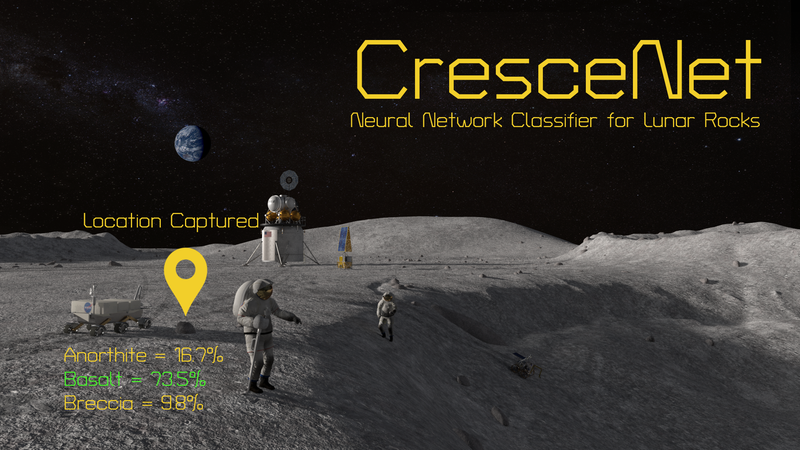
CresceNet
Convolutional Neural Network Classifier for lunar rock categories
Alternative Video Link :
Background
Last scoops of the Moon soil picked up by Neil Armstrong contained Anorthosite - evidence that the Moon was once a massive blob of lava. It was an accidental discovery at the time, but it led the Apollo 15 crew towards the discovery of the Genesis Rock. After 50 years, humans are planning to go back to the Moon to stay.
Our team developed CresceNet to speed up the discovery of unique rocks. Our goal is to increase the value of the scientific results by identifying rocks that do not fall within the known classification of lunar rocks. We will not leave any extraordinary rocks unturned.
What it does
CresceNet classifies lunar rocks to find the unique ones quickly and mark them so they could be picked up and brought back to the Earth to uncover the mysteries of the Solar System.
Using our neural network for rock classification saves critical astronaut time during the mission and increases the total scientific value of the samples significantly.
NASA database of the lunar rock samples under in-situ conditions is severely limited, hence we only used images available in lab conditions for the proof of concept. We would require more in-situ data to get better prediction results from neural networks.
Nonetheless, we managed to train the neural network on the data available using image transformation techniques, such as flipping and zooming in. This helped to predict the categories of the rocks with the accuracy of up to 70%. We hope to train our neural network in an environment that can simulate the Moon conditions here on Earth.
Our image recognition algorithm was trained on 3 rock categories, namely: Basalt, Breccia and Anorthosite. It is worth pointing out that the latter data type is undersampled, due to the rareness of it, which may cause our neural network to be biased. This could be solved by increasing the sample size.
NASA Resources
Our main source was NASA Curator website, specifically the Lunar Photo and Sample Catalog. Unfortunately, the Curator was down most of the time during this challenge, as a result, we used an alternative source to download rock samples and train our neural network.
NASA Curator Lunar Rocks Source: https://curator.jsc.nasa.gov/lunar/samplecatalog/i...
Lunar and Planetary Institute, Lunar Sample Atlas: https://www.lpi.usra.edu/lunar/samples/atlas/
Note: Our crafted photo IDs match the IDs on Curator Website (e.g. Basalt sample 10024 photo S69-46026 matches our cropped photo S69-46026 taken from Lunar Sample Atlas)
Space Apps Offers
We received information about the alternative data source from the moderator in the NASA Apps Chat.
Future Plans
We could obtain better accuracy using higher quality images and bigger data sets as well as the insights from NASA geologists. We are hoping to scale our neural network to enable robotic or manned rovers to scan the environment automatically. This way we would identify interesting anomalous objects and could collect them for further study. Therefore, time for astronaut training and walks on the surface would be reduced dramatically.
We hope to use CresceNet prototype in conjunction with the latest NASA developments. We would like to integrate CresceNet in NASA's LunaNet platform, helping astronauts to navigate the coordinates of the rock samples we will mark. Additionally, we foresee the scalability of our software for application in Mars 2020 rover. If the image data would be used in unison with other sources of data (SEM, 3D X-ray, XRF, etc.) in CresceNet we could achieve outstanding performance in object classification.
Moreover, our Neural Network could aid in medical screening; for example, determining the type of kidney and bladder stones in patients so they could receive appropriate treatment.
Here, on Earth, the same techniques could be used for geological expeditions and quality assessment of the soil for agriculture.
Built With
We built our app in Python 3.7. CresceNet was created and trained using Tensorflow and Keras. The model was served using Flask. Languages used for the presentation part were JavaScript, CSS and HTML.
Try it out
Our Lunar Rock classifier: http://whatin.space/
Project source: https://github.com/MonikaVen/NASA_SpaceApps_RockSt...
Cropped Lunar Rocks Dataset Used in ML Module: https://drive.google.com/drive/folders/1mfiWRPssAm...
Tags
#moon, #lunar rocks, #classifier, #neural networks, #basalt, #breccia, #anorthosite, #image recognition, #python, #javascript, #machine learning, #keras, #tensorflow, #geology