
S.A.S.S.I. | Eeny, Meeny, Miney, Sample!
Project Details
Awards & Nominations
S.A.S.S.I. has received the following awards and nominations. Way to go!
The Challenge | Eeny, Meeny, Miney, Sample!
S.A.S.S.I.
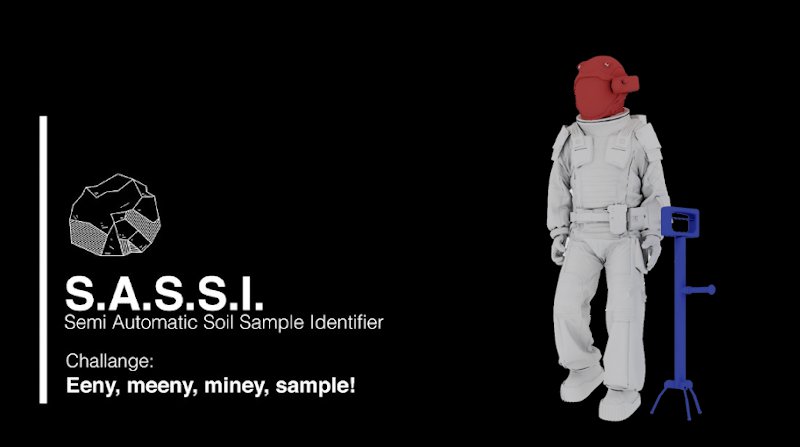
The Semi Automatic Soil Sample Identifier is a tool-kit that supports the astronauts during EVA and helps them navigate the moon with AR visor and hyperspectral camera. We also provide the astronauts with a new model of tongs
INTRODUCTION
The activity of sample collection was one of the most important EVA, providing scientists
many useful samples to study. These samples had a key role in understanding not only the history and the composition of the moon itself, but also earth's story.
Apollo mission brought back 382Kg of lunar rocks, however, scientists still need more proof to confirm these theories and this can only be achieved by collecting more samples. For this reason, sample collection EVA will surely be one of the keypoint activities of the next manned mission to the Moon such as Artemis. These EVA must bring back a higher sample mass in order to enrich the sample catalogue began with Apollo program and demonstrate technological advancement since then.
Sample collection must be performed in a more effective way. To do so astronauts must be able to recognize in situ the scientific value of a sample. Thus, they must be able to look for samples which have similarities or substantial differences to the ones already collected. To avoid astronauts the exposure to lunar ambient the task of collecting rocks – or soil – could be delegated to a robotic mission but, according to recent studies done by [1] CAPTEM Lunar Subcommittee, human missions are more effective and faster in collecting soil samples.
We chose to develop a toolkit for astronauts to enhance sample collection during Extra Vehicular Activity (EVA) and to enhance sample collection.
S.A.S.S.I. TOOLKIT
The toolkit is a set of instruments and utensils that assists astronauts during EVA on the surface of the Moon by providing almost real-time information of the composition of an identified sample, and a collecting system that grabs, tag and store – with no contamination – lunar rocks. The equipment includes a mixed reality smart helmet and an improved version of the tong instrument already used by Apollo astronauts to collect soil samples.
The toolkit comes into play when the astronauts are out on the moon surface. A landing site must be identified in order to reach the richest spot of valuable samples. The identification is done by using data of surface characteristics acquired by past prospecting missions such as the one provided by Lunar Reconnaissance Orbiter [6].
The following section explains in more detail all the components of the equipment

SMART HELMET
The components of the system are: a hyperspectral camera that takes pictures of what the astronauts is looking at and the augmented reality projector which beams the processed image with information and related data directly on the visor. The camera is mounted on the helmet while the projector is placed inside, above the astronaut’s head.

Spectral imaging is a well proven technology both in space and terrestrial applications. Also, cameras are becoming smaller and lighter [2]. Same considerations can be made for holographic projection technology. Hence, these systems can be utilized for moon sample identification and data visualization with minimum development costs.
RECOGNITION ALGORITHM
A machine learning algorithm has been developed in order to identify valuable samples – based on the data acquired.
The algorithm is educated on Earth by means of data clustering and k-means algorithm using chemical data from apollo samples and spectrographic data of the sample itself, acquired by a camera like the one in the toolkit. When the astronaut moves on the lunar surface the computer elaborates the images acquired by the camera and translates the colours in chemical composition.

The software lets the astronaut easily identify the most interesting samples and decide whether to collect them or not.
When the astronaut decides not to collect the sample the system automatically saves all the data collected up to that moment – since they could still have a scientific value. When they decide to collect the sample, (positive program response) the camera is used to take shots at different angles, which are later processed by the software to create a 3D model of the sample using photogrammetry. This process allows to store information of the sample geometry as it was on the moon, since during recovery and transportation the sample could break. The 3D model is also used by a bin packing algorithm which allows to store the maximum number of samples in the sample container – a limited volume. Scientists on Earth would also be able to use the 3D scans to experiment with the samples freely avoiding any damage to the rock itself.
TONG
The physical action of grabbing a sample from the lunar soil is difficult to carry out with the EVA suit. Furthermore, touching the sample with gloves may pose risks of contamination. The tong is designed to solve these problems. It’s made of a main hollow body with 3 mechanically trigged grippers that hook the sample and encapsulate it in a sealed Teflon® bag to prevent contamination. The bags are housed in the body, ready to be used. The grippers are used to extract Teflon bags and wrap the sample while grabbing it. The bag is then thermo-sealed by heated patch mounted on the gripper’s end.

After that, samples are automatically catalogued by scanning a unique identification code on the bag.
DATASHEET
Here you can find more detailed informations about the components

REFERENCES
[1] Analysis of Lunar Sample Mass Capability for the Lunar Exploration Architecture – CAPTEM Document 2007-01 https://www.lpi.usra.edu/lunar/strategies/captem_sample_return.pdf
[2]Lunar Sample Compendium https://curator.jsc.nasa.gov/lunar/lsc/
[3]CATALOG OF APOLLO LUNAR SURFACE GEOLOGICAL SAMPLING TOOLS AND CONTAINERS – J. H. Allton, Contract NAS 9-17900, Job Order J2-J60 https://curator.jsc.nasa.gov/lunar/catalogs/other/jsc23454toolcatalog.pdf
[4]Developing Sample Return Technology using the Earth’s Moon as a Testing Ground – Clive R. Neal, The Inner Planets Panel, NRC Decadal Survey for the Planetary Sciences Division, Science Mission Directorate, NASA. https://solarsystem.nasa.gov/studies/181/developing-sample-return-technology-using-the-earths-moon-as-a-testing-ground/
[5]Specim IQ Hyperspectral camera datasheet https://www.specim.fi/iq/tech-specs/