
No Team No Challenge| Build a Planet
Project Details
The Challenge | Build a Planet
Little Gods
Board Game
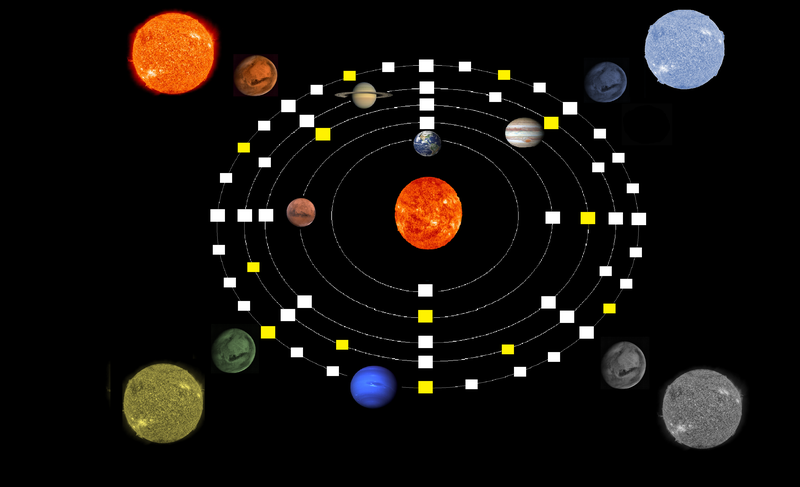
“Little Gods” – The Board Game
In an effort to make science approachable to everyone and especially to its biggest fans, children, we present to you “Little Gods”, the board game. “Little Gods” is a game combining not only knowledge but also fun.
The goal:
The goal is to introduce space and its elements to a bigger audience, in a simpler way with a recipe that never gets old. A board game. Our aspiration is to achieve the maximum perception of how our solar system works, what each planet in it has to offer, to inspire the exploration of outer space and last but definitely not least to focus on human interaction rather than entertainment through a screen.
The scenario:
Earth is on the verge of destruction and the need to colonize space is rising. But no existent planet covers the needs of human kind. So, you need to create your own star system, with the planet you will colonize, and a star which will play the role of your brand new sun! Board on your spaceship and the journey begins! Land on various planets of our solar system and either collect elements for your future planet or take advantage of the planet’s energy resources. Beware, though, because your spaceship and its crew have their own needs. Will you be able to create your new star system before Earth becomes not viable? Tik tok…
Contents:
- A board (from recycled paper) which depicts the solar system and in every corner there is each player’s new star system.
- 4 spaceship pawns
- 30 cards
- 40 tokens of elements that players will collect.
- 5 planet tokens
- Rulebook
Rules:
- 2 – 4 players.
- Average time of play 40 minutes.
- Age: 10 – 99+
- Purpose of the game: Be the first to create a star system that will consist of a viable planet and a star in the center of it.
- Setup:
Place the planet tokens in each orbit according to the following order from the inside to the outside -> Earth, Mars, Zeus, Saturn, Uranus. The planet tokens can be put randomly in a square of their defined orbit.
Then, place the element tokens on the planet tokens as following:
- Mars: 1 carbon (C) token, 2 oxygen (O) tokens
- Zeus: 1 nitrogen (N) token
- Saturn: 1 ferrum (Fe) token, 1 helium (He) token
- Uranus: 1 Hydrogen (H) token
Lastly, put the spaceship pawns on Earth.
- The youngest player goes first andthe game continues counterclockwise.
- The spaceships work with energy packages,5 packages being their full capacity. All players begin at full capacity. Ifyou run out of energy you cannot move. In order to refill, remain in your orbitfor a round and collect the amount of energy each orbit predicts. The closer tothe sun your orbit is, the more the energy packages you collect.
- MOVES: moving from one orbit toanother, whichever square inside an orbit or remaining on the same square orplanet.
- 2 MOVES
- 1 MOVE & 1 ACTION
- 2 ACTIONS
*You cannot collect tokens unless you are on a planet.
** You need 1 energy package to move orbits, or freely inside an orbit but 2 energy packages to collect a token, to dispose a token or to move from one system to another.
*** Collecting a card is not considered an action and can only be achieved if you step on a yellow square.
- During each round, the planet tokens move one square counterclockwise, always in their own orbit. This does not apply for the planet you are creating.
- If you move on a planet you do not wish to stay on, or collect a token from you can use the thrust of its orbit to gain an extra move without consuming energy packages.
Cards:
Below there are examples of the cards mentioned in the previous section. Note that the scenarios described in the cards can either help or delay the player:
- The planet you have landed on isunbearably cold, causing problems in your spaceship systems. In order to fixthe problem, you need to stay another round on the planet.
- You reached the International SpaceStation and filled your spaceship with supplies. Your spaceship’s energypackages are now +2.
- You randomly find water on theplanet you are on. Your energy packages are now +1.
- An asteroid crushes with yourspaceship and destroys one of your machines. Your energy packages are now -2.
Innovation:
The innovation of “Little Gods” lies within the fact that accurate information has been used to set the game. Firstly, the elements placed on each planet are scientifically proven to be there and at the same time the planets are placed on the board following the same order as in real life. The cards are, for the most part, describing scenarios that could happen on a real mission conducted by a spaceship crew. Moreover, the energy on each orbit is bigger while closer to the sun and is reduced while moving to the outside, following the real-life pattern. Also, the number of squares placed in every orbit doubles each time, creating a continually increasing orbit, resulting to bigger orbits of the planets further from the Sun. So essentially, Saturn has a wider orbit than Earth verifying the current image that we have of the solar system. Last but not least, the exploitation of an orbit’s thrust is a technique, currently, used by scientists and is implemented to send satellites in space.