
Sajans| Build a Planet
Project Details
Awards & Nominations
Sajans has received the following awards and nominations. Way to go!
The Challenge | Build a Planet
EXOSELFIE
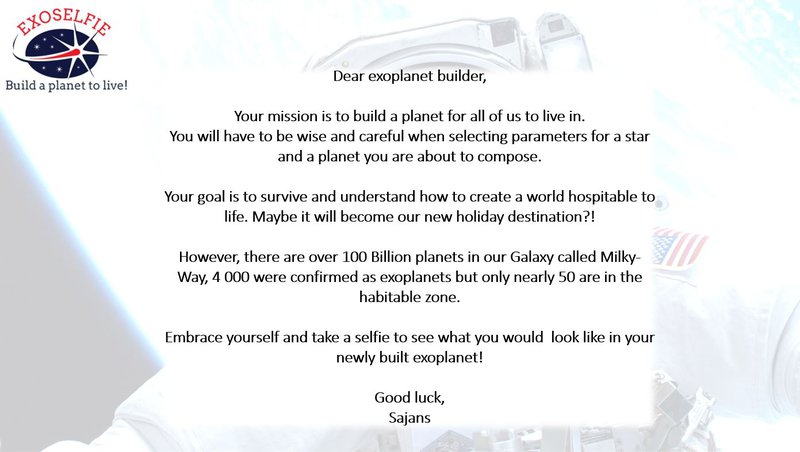
Build a planet to live and make a selfie on it!
Why?
Our team met at the office, but we became friends because of passion for data science, physics and things that make a difference. We like to build stuff! We want to empower our app users to feel the glory of building exotic things and get to know more about the universe that we live in while doing it.
What does it do?
EXOSELFIE allows you to build a planet and take a selfie on it!
This educational game allows you to shape your photo filter by controlling physical parameters of an exoplanet and its host star. Your chances of survival are then estimated using calculated planet’s gravity and temperature – some of the most important physical parameters regarding planet’s habitability. A detailed description of your modelled world is also displayed alongside.
Be aware – survival in distant worlds is not as easy as it may seem!
What’s under the hood?
Inputs
The application currently functions by taking
- Planet’s mass;
- Planet’s radius;
- Planet’s distance from the star;
- Effective star temperature;
- Stellar radius;
- Your photo
from the user interface and calculating planet’s temperature and star’s spectrum that are used for photo editing.
Along with user inputs, NASA’s open-access exoplanet database is used for retrieving parameters of existing exoplanets for comparison and modelled parameter calibration. Data from NASA’s publication Environment of Manned Systems is used as data for calibration of extreme temperature survival model.
Methods
Planet’s surface temperature is estimated using planetary equilibrium temperature model. Albedo is set at a zero because low albedo compensates for greenhouse effect that is too complex to estimate at the current stage. Surface gravity is calculated using the law of universal gravitation.
Human survival time in extreme temperatures is calculated using an exponential law that is an approximation to the law described in NASA’s The Human Factor: log(t) = a * exp(-b * dT) + c. The parameters are calibrated using NASA’s Environment of Manned Systems data.
Star’s spectral intensity is estimated by feeding host star’s temperature into Planck’s law at 3 wavelengths – 610, 550 and 465 nm – that represent the RGB color model.

Transformations are applied to the user’s picture using RGB and T estimation results:
- Photo is combined with an icy or fiery – depending on the temperature hazard – picture via a method called Neural Style Transfer
- The combined picture is blended with the original picture by utilizing a weight factor that depends on the severity of the temperature hazard
- RGB encoded color tint that depends on stellar temperature is applied to the blended picture.
An existing exoplanet with a high similarity score is found in the NASA’s exoplanet database. Similarity score is estimated by calculating the geometric mean of G similarity and T similarity. These are calculated as absolute differences between modelled and existing planet parameters, divided by larger one of these parameters.
Outputs
A modified picture and a description of the encountered conditions are provided to the user. A description of a real exoplanet from NASA’s exoplanet database with a high similarity score is added to the summary. Overall these values are calculated and outputted to the user in one form or another:
- Planet's surface temperature (degrees Celsius)
- Planet's surface gravity (G)
- Estimated light intensity at three wavelengths representing R, G and B color-coding
- Explanatory text on survival capabilities and features of newly created planet
- Planet similarity score and most similar exoplanet in NASA's exoplanet archive
NASA Resources
Data:
https://exoplanetarchive.ipac.caltech.edu/docs/data.html
References:
https://exoplanets.nasa.gov/what-is-an-exoplanet/how-do-we-find-habitable-planets/
https://science.nasa.gov/science-news/science-at-nasa/2001/ast02aug_1
https://history.nasa.gov/SP-4213.pdf
Space Apps Offers
Since our team does not have front-end experience we asked for a html coding related help. We were advised on which templates to begin with and, later, got some tips. We are super happy to learn how to code in html in few hours. Also, our results show that we got help right on the spot. Thanks!
Future Plans
- EXOSELFIE app is an educational popularizer of science with potential over 100 000 downloads (compared to ‘Rocket Science 101’ by NASA downloads on Google Play).
- EXOSELFIE is a potential solution for Facebook & Instagram as filters ‘Greetings from exoplanet’.
- EXOSELFIE can be used in schools as an educational tool.
- EXOSELFIE will serve as myth buster for alien-related topics. Also, provides evidences and knowledge to a wide audience on habitable zone and exoplanet topics.
Built with
EDA (exploratory data analysis): Python, Jupyter
Back-end: Python, TensorFlow, Flask, Docker
Front-end: HTML, bootstrap core CSS, bootstrap core JavaScript
Try it out
https://github.com/MinorDudle/nasa_hack
*Application is dockerized so that anyone can run it on their system. Look for instructions in read me.
Tags
#exoselfie #buildaplanettolive #bestfiltersintheuniverse #mythbusters #datascience #neuralstyletransfer #javascript #html #python #css #jupyternotebook #flask #tensorflow #selfie #instagram #wewanttowin #science #astrophysics #exoplanet #game #educatioalngame #docker