
Space Pirates| Build a Planet
Project Details
Awards & Nominations
Space Pirates has received the following awards and nominations. Way to go!
The Challenge | Build a Planet
PlanetApp
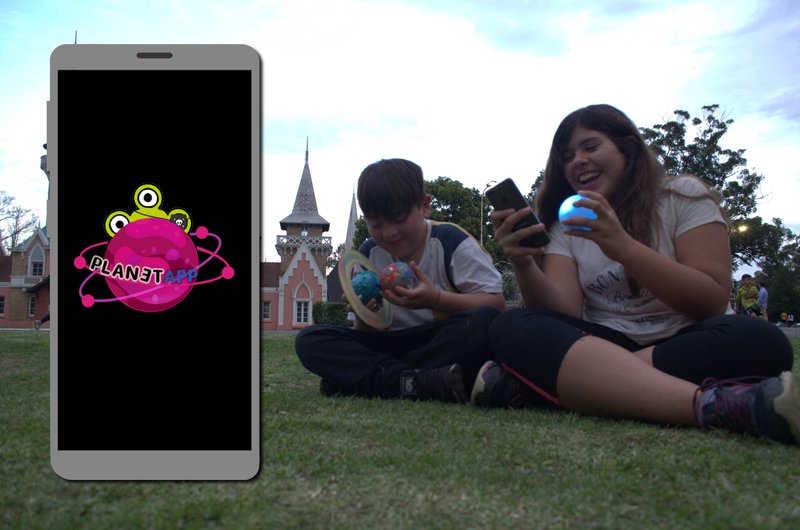
The purpose of this pedagogical project is to inspire interest in planetary studies. With PlanetApp we create a fun environment where children can get to know our universe, using all their senses.
ABOUT US:
We are students at the Universidad Nacional de la Plata (UNLP). We each have a different area of study, such as Computer Science, Astronomy, Geophysics, Visual Design and Engineering. We met and created a group we called “Space Pirates,” and we chose “Challenge: Build a Planet” as our theme.
We chosen this theme because we seek to foster curiosity to inspire children to learn more about stars and planets.
WHAT IS PLANETPP?

PLANETAPP is a game that generates a simulation of a planetary system. The game takes data provided by the players and orbits the system around a cell phone that plays the role of star, through which you can access the application where these data will be used to build the systemic trace. Accessorily, the game has a luminous and sonorous spherical figure, representative of a planet, that the player will be able to use optionally to relieve his attributes and simulate planetary movements that will be used by the simulation.
With that goal in mind, we begin our task by analyzing the essential characteristics that we must collect our program and the data that we must use, and how to show them in the most efficient way. Subsequently, after outlining the plan to follow, we launched the development of a software that simulates a Planetary System based on the data provided by the different actors of the network.
State Transition Diagram.

EXPLAINING THE SOLUTION
With the solution proposed by our team, we focus on "breaking" the barrier of fear of hard sciences, such as astrophysics, bringing this topic closer to children, developing an application for smartphones, which generates 3D spherical images based on physical designs created by themselves. It is able to collect, process and display data in real time (using real formulas and data provided by NASA) on the functioning of the Planetary System as a whole. Generating a playful and friendly teaching environment.
The game has two modalities: solitaire or multiplayer. In the Single Mode, the user is familiarized with the use of App and terminology, in addition to practicing some simulations (both real systems extracted from genuine planetary systems and fictitious systems modelled by the player himself). In this mode the only role that can be assumed is that of planet. On the other hand, the multiplayer mode extracts the player from the screen to interact with the planet models, together with their friends, in a dynamic physical way. In multiplayer mode the players move around the star pretending to be the planets. In this case the players can choose to be the star around which the whole system revolves or assume the planetary role. The astro cell behaves like the server to which the planets that make up the system are connected.
In PLANETAPP you can create as many planetary systems as you want or save a system already built to continue playing with it at another time. The simulation allows to know the most important elements that conform this type of systems, that is to say, it counts on the planetary system and its star, its planets, its natural satellites and rings. It also makes the accounts and equations necessary to calculate the gravity, orbit and distance of the elements and their variations when moving the sphere and in this way increase or decrease its orbit.
As the planetary model is built and modifications are made, the software accompanies the player with a virtual guide that guides him in his creation and that throughout the game provides scientific data on the characteristics it possesses.
The mission is to bring children closer to the knowledge of planetary systems and their functioning.
PLANETAPP is an interactive game based on scientific data whose team responsible for its birth is made up of an interdisciplinary group of students.
Design and construction of the interactive planet.
Objective:
It seeks to create a wireless base on which a boy older than 9 years can mold his own planet through artistic elements. This base must be able to maintain a connection with a mobile device and capture the attention of children by changing color. It must also be able to alert children if required.
Design:
It is considered to use Open Source technology, as it is Arduino, to design the base where children will model their planets. This is accessible to any school. This gives the possibility that the construction of the bases is proper of the schools. In this way we also encourage the development of technological skills and knowledge.
It was decided to make a printed base in 3D due to the great growth of this technology already found in many schools. And it uses a degradable and non-toxic material (PLA).
FUTURE PLANS (SOFTWARE-SCIENCE):
1-Integrate stellar systems to the simulation. by default they are filtered so as not to lead to inconsistencies. but in the future with modified versions of the problem of the two bodies. and some tools of numerical analysis, we could estimate orbits and deviations in a coherent simulation.
2-Make the best use of the available information. for example explain the general fundamentals of photometry, the photometric system, its relationship with the composition of stars. explain and expand phenomena such as the "gravitational lens", and its applicability in methods such as microlensing.
3-Use density data to estimate compounds and physical processes present on various exoplanets (real and user-generated).
4-Generate rigorous atmospheric simulations, with diverse gaseous chemical compounds, that coincide with the incident radiation of the star, and the probability that the compound is present in the planet (the composition of the atmosphere of your planet has X probability of existing).
5-Extend the measurement methods to the smallest ones, why do we know that the star is to those parsecs of distance? how do we know the radius of the exoplanet? explain the methods used and relate them to the real instruments.
After Space Apps 2019 we are going to continue working on this project because we are determined that with this project we are going to teach children in a unique and different way about stars and planets.
More information about the project and their Backend in:
https://drive.google.com/drive/folders/1QL4BQZwwE2...
Fault:
-Functional approach.
-Comprehensive application, multiple learning themes.
Vision:
-Rethinking concepts
-Multitask to all participants.
Resource used:
- Exoplanetshttps://exoplanets.nasa.gov
- Solar system modelinghttps://www.jpl.nasa.gov/edu/teach/activity/modeli...
- Formation of solar systemshttps://www.jpl.nasa.gov/edu/learn/video/space-pla...
- Mission Keplerhttps://www.nasa.gov/mission_pages/kepler/overview...
- Planetshttps://solarsystem.nasa.gov/planets/overview/
- API https://exoplanetarchive.ipac.caltech.edu/docs/pro...
- CHZ https://es.wikipedia.org/wiki/Zona_de_habitabilida...
- How do we find lifehttps://exoplanets.nasa.gov/what-is-an-exoplanet/how-do-we-find-life/
- The exoplanet transit methodhttps://www.paulanthonywilson.com/exoplanets/exoplanet-detection-techniques/the-exoplanet-transit-method/
- How to Build a Planet (Inspirational) https://www.youtube.com/watch?v=1-ibOQM7Ua0
- Ellipse analysis:
- Physics Books:
- R. Resnick, D. Halliday, y KS Krane, "Física" vol. YO.
- PA Tipler, "Física" Me .
- RA Serway y JW Jewett, Jr., "Fisica I" .
- PA Tipler, "Física" Me .
- Numerical analysis:
- Richard L. Burden y J. Douglas Faires. 'Análisis numérico'.
Use of python (backend):
https://github.com/carlosmcastro/NASA-Space-APP_Ba...
Use of C # Script for the simulation of the stellar system of the unit:
https://github.com/krasorx/NasaSpaceAppChallenge
"It is good to know that the means and the capacity exist to generate that beautiful curiosity that allows us to explore with meticulousness and admiration how vast and diverse the universe is. And above all, that in the shelter of this small pale blue planet, we can generate a help to that youth hungry for curiosity and good wishes".
"Es bueno saber que existen los medios y la capacidad para generar esa hermosa curiosidad que nos permite explorar con meticulosidad y admiración cuán vasto y diverso es el universo. Y, sobre todo, en el refugio de este pequeño planeta azul pálido, nosotros puede generar ayuda para aquellos jóvenes hambrientos de curiosidad y buenos deseos ".
#solarsystem #plantets #PlanetApp # Kepler #exoplanet #Sun #Mars#planetarysystem #NASASPACEAPPSCHALLENCHE #CHZ #MOON #ORBITAL