
SpaceCats| Build a Planet
Project Details
The Challenge | Build a Planet
Space Cats!
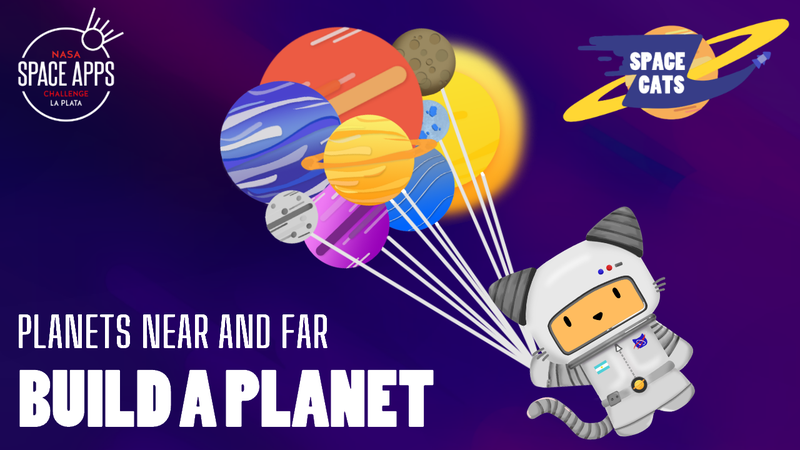
A collaborative, educational mobile game where you can build your own planet around the star of your choice!
WHO ARE WE? WHAT MAKES OUR TEAM SPECIAL?
3, 2, 1, GO! We are the SPACE CATS! 3 Designers, 2 IT Guys and 1 Engineer. A motivated and diverse group from all fields of study all united with a shared vision: Making the world a better place for future generations.
WHY IS THIS TOPIC IMPORTANT?
This topic is important because it naturally brings up people from different fields together. It promotes a message of union, of getting stronger if we are in community. We are just a tiny tiny part of the observable universe and we've made wonders together as a humanity, but we still have a long way to explore! And together, we get further.
HOW DOES OUR SOLUTION WORK?
We want to create a playful experience around the "Build a Planet" Subtopic NASA challenged us. We chose to create this experience in the format of a Mobile Game. In the game, the player creates a user in a server, gets to choose between a set of G-Class Stars and then builds their own planet that can reasonably exist in that star's planetary system. In order to build their planet, they will have a menu where they can choose different characteristics: Composition (Is it mostly Gas, Ice or is it Rocky?), Distance to Star (Close, Far, or a Middle Distance?), Size (Small, Medium or Large?), Gravity (Low, Medium, High?), Rings (Yes or No?), Satellites (Yes or No?), Atmosphere (Thin or Thick?), and of course, Name their planet. And the user is all set! They will find a community of people who also chose to live in the star of their choice! But here comes the fun part: There will also be Mini-Games (In relation of Taking Care of our Environment, Classifying Moon Samples, and other topics of this year's SpaceApps Challenges) where they can play and earn points for their planet to evolve and rank between their friends.
WHAT IS OUR IDEA'S IMPACT? WHAT DO WE NEED TO GET THIS DONE?
We, together as humans, have made huge progress together and we still have a long way to go. We've made possible things that a couple of years ago were considered a dream. We believe that our kids will be the main characters on expanding the limits of knowledge of today. We believe they will be the inventors, the scientists, the poets, the artists of a future we can't even conceive today. That's why we have to give them the tools, teach them what we've already found and generate this interest from an early age. We believe in our kids, we believe that kids will save our future.
We have progressed a lot in just one night! And that has been possible due to the diverse nature of our group. Imagine what we could do if we had a group of space scientists to give us a more accurate description of Planetary Systems, if we could further master our chosen game development framework, even if we could have educators by our side teaching us innovative ways to get closer to our kids! A shared community grows stronger. We still have a long way to go. But together we've demonstrated that everything that we dream, everything that we put our mind into can be possible with an awesome team and a shared vision.
RESOURCES
- NASA Solar System Exploration. (April 10, 2019). "What is a Planet?" https://solarsystem.nasa.gov/planets/in-depth/
- NASA Space Place. (June 28, 2019) "How Many Solar Systems Are In Our Galaxy?" https://spaceplace.nasa.gov/other-solar-systems/en...
- Steigerwald, Bill. (March 10, 2019) "Goldilocks Stars May Be 'Just Right' For Finding Habitable Worlds" https://www.nasa.gov/feature/goddard/2019/k-star-a...
- NASA Solar System Exploration. (April 29, 2019) "Our Solar System - In Depth" https://solarsystem.nasa.gov/solar-system/our-sola...
- NASA Space Place (June 27, 2019) "What Is A Galaxy?" https://spaceplace.nasa.gov/galaxy/en/
- NASA Space Place (June 27, 2019) "Why Are Planets Round?" https://spaceplace.nasa.gov/planets-round/en/