
The Rock| Build a Planet
Project Details
The Challenge | Build a Planet
PlanetCraft
Interactive game aimed to give educational notions to young users about the stars which populate our universe and related star systems. Moreover the game allows the user to customize a reasonable planet within the star system.
PROJECT OVERVIEW:
With a common background in basics astrophysics, five students at the second year of Space Engineering master decided to put in practice the notions that they are learning following the "Space Physics" course of Professor Giovanni Consolati.
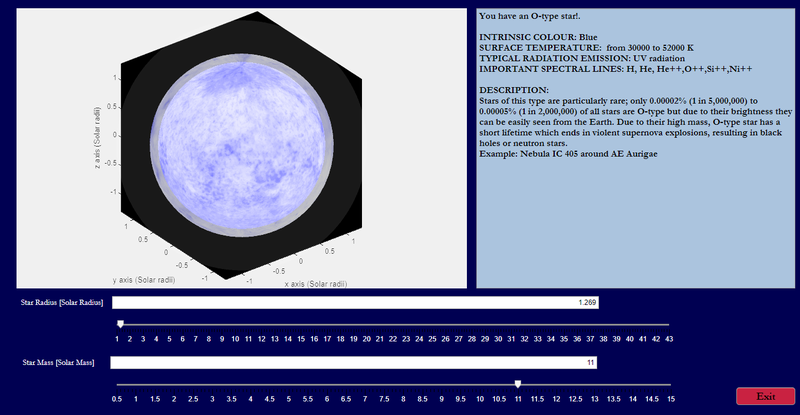
The first challenge consisted in the game design.The solution was to divide the game in three different parts: customization of the star, customization of the star system and the customization of the planet. A brief description of the spectral class of the chosen star and an example of a real existing one are provided.
The uses can characterize the star by imputing its mass and its radius, but the choice is constrained only on stars belonging to main sequence due to their stable behavior. This causes the fact that they are best solution in order to the describe almost the majority of the stars.
The star system is generated based on the thermal distances obtained exploiting the luminosity of the star. So it is possible to define a minimum habitability radius, a maximum one and a threshold radius (frost line) useful to characterize the typology of the planet (terrestrial or gaseous).
Once defined the main features of planet (mass, radius and distance from the star), the user can customize it changing the surface composition and as a consequence theatmosphere. As for the star, a brief description of the planet about its main features are provided.
The game was coded in Matlab software using the tool App Designer.
Possible refinements can be achieved optimizing the code in order to reduce the computational time. A better quality in the texture can improve the game experience enhancing the object details. The game is open for future developments like implementing more complex astrophysical and chemical models in order to obtain more precise and accurate results.
APP
GitHub: https://github.com/JackCrusoe47/THE_ROCK.git
Google Drive: https://drive.google.com/drive/folders/1g5y0FHlO5p...
STAR:
From Radius and Mass to Luminosity, Surface Temperature, Star timelife, Core Temperature, Core Pressure
H. Karttunen, Fundamental Astronomy ch.4,5,9,11
http://www.cosmos.esa.int/web/hipparcos/millenium-star-atlas
http://www.cosmos.esa.int/web/gaia
SYSTEM:
Thermal Radii from the star luminosity
https://worldbuilding.stackexchange.com/questions/116170/how-to-estimate-a-stars-heliopause
G. Vladilo, Formation of Planetary System: Observational Constraints
M. Gudel, R. Dvorak, N. Erakaev, M. Khodachenko, H. Lammer, E. Pilat-Lohinger, H. Rauer, I. Ribas, B. E. Wood, Astrophysical Conditions for Planetary Habitability
PLANET:
Form Mass and Radius to Orbital Parameter
H. D. Curtis, Orbital Mechanics for Engineering Students 3rd Edition.
ATMOSPHERE:
E. Dobos,University of Misckolc, Albedo, 2003
Baines K. H., Atreya S. K., Bullock M. A., Grinspoon D. H., Mahaffy P., Russell C. T., Schubert G., and Zahnle K. (2013) The atmospheresof the terrestrial planets: Clues to the origins and early evolution of Venus, Earth, and Mars. In Comparative Climatology of Terrestrial Planets (S.J. Mackwell et al., eds.), pp. XX–YY. Univ. of Arizona, Tucson, DOI: 10.2458/azu_uapress_9780816530595-ch006.
A.Asadpoordarvish, The Atmospheres of Different Planets, 2010
NASA RESOURCES:
https://solarsystem.nasa.gov/planets/overview/
https://www.nasa.gov/mission_pages/kepler/overview/index.html
https://www.jpl.nasa.gov/edu/learn/video/space-place-in-a-snap-the-solar-systems-formation/
https://www.jpl.nasa.gov/edu/teach/activity/modeling-the-structure-of-the-solar-system/