
The Scrambled Space| Build a Planet
Project Details
The Challenge | Build a Planet
Planetobia
A 3D game enables the user to make a new planetary system with their own liking, by adding the star, adjusting its physical properties, and putting planets, satellites and celestial bodies he wants. The user will attain any info through trial and error.
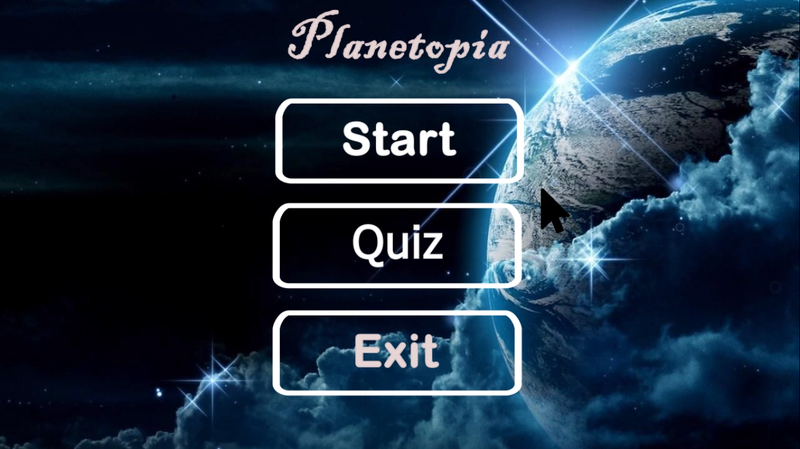
Our idea is to build a game that allows the user to customize the characteristics of a star and design planets. At first, the user will be asked to select the temperature and the mass of the star. From the temperature, the color of the star will be determined. And from the mass, the luminosity will be calculated using Eddington luminosity limit:
L = 3.2 * 10^4 (M/Msun)*Lsun
After determining the luminosity and the temperature, we will be able to determine the position of the star on the HR diagram knowing its lifetime and type.
After that the radius will be calculated automatically from the inverse square law:
L=σT44πR2.
Then, we will be able to calculate the gravity of the star using Newton’s law of universal gravitation: g = GM /r2.
Finally, the hill sphere of the star using this law:
Hs = α3(M/3m)^1/3
Hill sphere is the concept that determines the maximum distance at which the star could attract planets.
There are two cases that will be impossible for its planets to be habitable:
- The first case if the star was white dwarf M < 1.44ꙩ and T > 100 000 K: The habitable zone would be so close to the star that the tidal force will strongly affect the liquid water on its surface, causing the planet to lose it.
- The second case if the star was a neutron star T > 600 000 K: The rays coming from the star would be harmful that no life could sustain on the planet.
In these two cases the planets of the star will be surely inhabitable.
After that the star will be displayed in the game.
Then, the player will be asked to enter the mass and the distance of the planets.
From the distance we will be able to determine the zone of the planet:
- The planet must be in the hill sphere of the star.
- The planet must be outside the hill sphere of any other planet.
After determining the zone of the planet, we will be able to determine if the planet terrestrial or gaseous.
Also, we will be able to calculate the temperature of the planet using this law:
T= ((Ks*(1-A))/4σ)^1/4Where Ks is the star isolation and its value is:
Ks = L/d^2
After that the orbital velocity of the planet will be calculated using this law:
V= (Gm)^1/2/R
And the time of the orbital period will be calculated using this law:
T^2= (4π^2)/G(M1+M2 ) * a^3
Where a is semi major axis of the eclipse.
For the atmosphere the player will determine if he wants melted metals in the core or not:
- If the melted metal option was chosen, there will be a flow of melted metals in the core causing a magnetic field for the planet that keeps some elements like oxygen.
- If the melted metals option weren’t chosen, there won’t be a magnetic field for the planet and thus oxygen will rarely exist in the atmosphere and carbon dioxide will be spread the most.
From the previous information we will be able to determine if the planet is habitable or not.
For the planet to be habitable:
- It must be terrestrial.
- Its temperature must be in habitable range (0 – 50) ⁰C.
- Its core must have molten metals thus it will have a magnetic field and enough amount of oxygen in its atmosphere.
- It must rotate around its axis.
And after that the planet will be displayed in the game.
The user will be allowed to create satellites for each planet , but the distance from the satellite to the planet must not exceed the Roche limit which is calculated using this equation:
R = r*(16*M/m)1/3 ≈ 2.5*r*(M/m)1/3
Where M is the mass of the planet and m is the mass of the satellite.
Also, the satellite must be within the hill sphere of the planet:
Hs = α3(M/3m)^1/3
Where:
α = the distance between the two objects in whatever units are desired (usually AU);
M = the mass of the primary (more massive) body, in whatever units are desired;
m = the mass of the secondary body (in the same units as M);
Hs = the outer limit of the Hill sphere (in the same units as α)
So that if the planet exceeds this limit it won’t be affected by the gravitational force of the star or if the moon exceeds this limit it won’t be affected by the gravitational force of the planet.
Our game simulation:
https://www.youtube.com/watch?v=SW5h51qKSfI
List of resources:
William J. (2008) - Universe, Ch 7 & 17 & 20, from: https://drive.google.com/open?id=1OjYA0KB7cmhl2N5d...
https://www.astro.princeton.edu/~gk/A403/massive.p...https://exoplanets.nasa.gov/what-is-an-exoplanet/how-do-we-find-habitable-planets
http://www.geoastro.de/astro/stars/roche.htm
http://www.mikepeel.net/physics/mphys/pc3692/8. ...
https://www.researchgate.net/publication/328195196..
https://www.maplesoft.com/content/EngineeringFunda..