
Mate con tortitas| The Memory-Maker
Project Details
The Challenge | The Memory-Maker
Split Communication System
A communication system splited in two parts to allow data transit between low energy rovers in Venus and satellites.
WHO WE ARE
Hello! We are the team “Mate con Tortitas”, this is spanish for: a traditional South American caffeine-rich infused drink plus a baked flat-bun-like snack with characteristic fat content of the Province of Mendoza, Argentina; that's our home!

PROBLEM DETAILS
“Communicating the data back to earth is the most challenging aspect of the system design but multiple options are open for study” - AUTOMATON ROVER FOR EXTREME ENVIRONMENTS NASA Innovative Advanced Concepts (NIAC) Phase I Final Report
Traditional electronics do not work well on Venus, and memory is one of the biggest challenges. Our challenge was to develop mechanical approaches to accomplishing tasks normally done electronically within the context of space exploration.
VENUS’S ENVIRONMENTAL CONDITIONS
Venus is one of the most hostile planetary environments in the solar system.
Venus temperature is normally over 450°C.
It’s surface pressure is 92 bar.
In Venus’s hot temperature are only few types of electronics that work : those based on silicon carbide and gallium nitride. Unfortunately, the state of the art for these systems is a few hundred transistors (basically the processing power of a solar-powered calculator), so they are highly limited in what they can do, and they consume a lot of power.
ROBUST LANDERS (ROVERS)
Traditional extreme environment vehicles collect as many diverse data points as possible in the short period of time before system failure (which is between 23 to 127 minutes before the electronics failed in the hostile environment.)
- Modern Venus flagship mission concepts rely phase change materials, which extend life by only a few hours, or complex refrigeration concepts that are not ready for flight implementation.
OPPORTUNITY
“Steampunk science fiction meets spacecraft technology” - Jonathan Sauder
NASA Jet Propulsion Laboratory
Automaton Rover for Extreme Environments (AREE)
AREE breaks the traditional rover trend by exploring what can be done with only basic scientific measurements, but recorded over long periods of time.
Power is generated by a wind turbine built for the dense atmosphere on Venus and a clock spring that can store and release power concurrently. Power is then distributed throughout the rest of the vehicle as needed.
The Jansen mechanisms legs are guided by a mechanical computer and logic system, programed to carry out the mission.
It is able to collect basic science data such as wind speed, temperature, and seismic events.

“Divide et impera” - Julio Cesar
SCP (Split Communication System) is the solution we came along to solve the challenge of making a mechanical approach to operate a rover in Venus.
We decided to go the extra mile, and design a system that provides an easy-understanding way of collect, store and get data from Venus to Earth despite all of the specially strange conditions of this planet.
SCS it is composed of three important components. AREE (Automaton Rover for Extreme Environments) created by NASA, with a mechanical-electrical "Eiae" that we design, a stationary rover we decided to call “Caiaita” with a memory, and finally a geostationary satellite. This three elements combined, allows to extract, save, and send Venus data to Earth.
Communication between the satellite, the stationary rover and the AREE
In order to be able to collect the information and send it to us, instead of designing a memory, we attempt to generate a link through simple electrical circuits that work in Venus’s conditions, being able to make the transfer of magnetic waves and information.
So, we run into a first challenge: Going from Venus to a satellite mean using a lot of energy. A power we can not get with the same rover. As a solution, we thought about transmitting a electromagnetic wave between devices in the same planet (this means expending less power than from a planet to a satellite).
We can split this communications, the first with much less power (which is simply the AREE but with a twist that we will explain later!), and another one that can receive the information collected by the AREE, and send it to a satellite. Both of the last ones we mention, should be on a stationary position. This way, the wave is not generated by the AREE, instead, it is generated by the geostationary satellite, and the stationary base “Caiaita” will reflect, or not, the wave. Therefore, we transfer the information in a simple way.
SCS implies that the power to generate the information to send the wave trespassing the planet vertically it’s not coming from the planet, but from the satellite that has the necessary power to do it.
Now we face a new challenge: the sulfuric acid clouds that block transmissions, in those cases you could not transmit information or you could lose it. We decided to solve this through two separate mechanism:
A chemical mechanism that detects the ions that the clouds generate, so the “Caiaita” base, once it detects this, will stop transferring the information to the satellite.
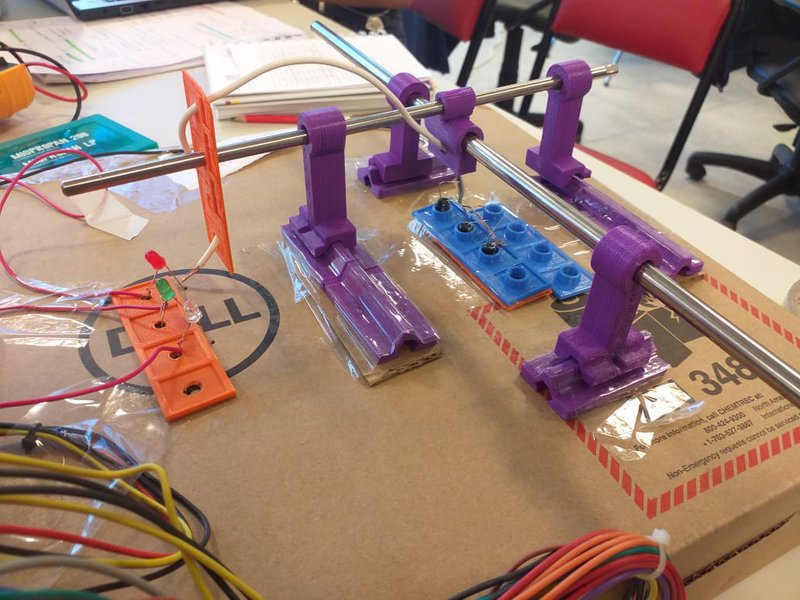
To store the information while the clouds are blocking the communication, we designed a mechanic memory. We start generating the bit. The minimum amount of information to replicate the bit. After discussing various options we opted for developing a memory with capacitors.
The capacitors are passive electric elements that store energy in form of an electric field, in other words, devices that can store electric energy. Each capacitor can be a bit. If we charge it, it means “1”, and if we don’t, it means “0”.
But, we need a lot of bits! As many bits as possible, therefore they have to be very small. Instead of using the usual commercial capacitors, we can develop smaller capacitors.
Small Capacitors Components
- Aluminum plaque
- Insulating mica plaque for high temperatures
- Aluminum wires.
It does not look like a capacitor but each aluminum wire would be the first terminal of a capacitor, the mica plaque the insulator of the medium and the other terminal of the capacitors united (the aluminum plaque on the other side).
Secondary problems we solved:
How to code the mechanical into electrical: The instruments are mechanical, so, to be able to save the electrical information we design a little device that converts the analog to digital in order to save it later. How it saves? We have a plaque with a pointer that reads each capacitor, to read or write, it sweeps them all. When it writes with a tension source from a capacitor or solar panel, when it sweeps each one, it sweeps the bits.
When the device is on earth, and it detects that there are no sulfuric acid clouds, and it activates the reading process and sends the data. It detects when the waves of the satellite hit and starts to sweep each capacitor, and if it has electric current, it reflects the wave, if not, it doesn’t.
Conclusions:
We thought this system to be used in Venus (it also applies in other planets with similar conditions), however, to make the memory and the writing and reading system, we end up making a
pseudo-Turing machine, a mechanical computer.
As a collateral positive result, we think that this system is also a useful way for teachers to teach kids about computers, to understand on a very visual way (considering everything in computers is so small and less visual) how a computer works.
Future plans
- Design sweep mechanism
- Further research on the laser idea
More info!
More information and project documentation can be found at
https://drive.google.com/open?id=1f0WPs16lPmFmYMYI...
Bibliography
- Venus
- https://www.nasa.gov/exploration/whyweexplore/Why_We_22.html
- https://solarsystem.nasa.gov/planets/venus/overview/
- Atmósfera de venus
- https://es.wikipedia.org/wiki/Atm%C3%B3sfera_de_Venus
- Magnetopausa
- https://es.wikipedia.org/wiki/Magnetopausa
- Onda de choque
- https://es.wikipedia.org/wiki/Onda_de_choque
- Magnetosfera
- https://es.wikipedia.org/wiki/Magnetosfera
- Vibraciones mecánicas
- https://www.educarex.es/pub/cont/com/0055/documentos/10_Informaci%C3%B3n/02_Fichas_generales/Vibraciones_mecanicas.pdf
- Bajo nubes de ácido sulfúrico
- https://elpais.com/diario/2006/04/12/sociedad/1144792803_850215.html
- Ecuaciones de Maxwell
- https://es.wikipedia.org/wiki/Ecuaciones_de_Maxwell
- Máquina de turin
- https://www.matesfacil.com/automatas-lenguajes/Maquina-Turing.html
- Temperatura de Curie
- https://es.wikipedia.org/wiki/Temperatura_de_Curie
- Propagación de ondas electromagnéticas
- https://sites.google.com/a/uaem.mx/satelites-artificiales/propagacion-de-ondas-electromagneticas
- Propagación de ondas desde satélite
- https://es.wikipedia.org/wiki/Comunicaciones_por_sat%C3%A9lite
- Satélites de baja órbita
- https://es.wikipedia.org/wiki/Sat%C3%A9lite_de_comunicaciones#Sat%C3%A9lites_de_%C3%B3rbita_baja_(LEO)
- Satélite Atsuki
- https://en.wikipedia.org/wiki/Akatsuki_(spacecraft)
- Temperatura de juntura del Laser
- https://es.wikipedia.org/wiki/Temperatura_de_uni%C3%B3n
- Propagación de ondas: absorción y atenuación
- http://propagaciondeondascom1.blogspot.com/2012/11/atenuacion-y-absorcion-de-ondas.html
- Mica
- https://es.wikipedia.org/wiki/Mica
- http://www.micaprop.com.ar/
- Página de dieléctricos (donde seleccionamos el material)
- http://dielectra.com/aislantes-dielectricos/
- Vidrio templado
- https://www.monografias.com/trabajos11/vidrio/vidr...
- https://www.vidriopanel.es/blog/todo-lo-que-debes-...