Ram Makers II| The Memory-Maker
Team Updates
References:
1 - https://www.nasa.gov/feature/automaton-rover-for-e...
2 - https://solarsystem.nasa.gov/planets/venus/in-dept...
3 -
4 - https://www.google.com/url?sa=t&source=web&rct=j&url=https://lgg.epfl.ch/publications/2013/mechAuto/functional_modeling_slides.pdf&ved=2ahUKEwjA5be2jr_lAhUbILkGHQxmDCUQFjAAegQIARAB&usg=AOvVaw0okakFiYWCDurOo3fK2OK-
 Juliano Pedro da Silva Juliano Pedro da Silva
 MEMORY CREATOR: THE MECHANICAL COMPUTER
The mechanical computer is a simple analog system constructed of gears, levers and pistons that uses the transmission of motion between these elements to generate binary outputs 0 and 1.
Over time, information storage technologies have evolved as ever more autonomous systems need to be created. Mechanical computers were instrumental in developing faster data processing systems such as modern electronic computers.
In addition, the mechanical computer still has several applications in the industry and, especially, when it is intended to work with the capture of information in extreme environments, it shows that, even with its simplicity of construction and the low cost of production, it surpasses other methods of traditional electronics.
PRODUCT APPLICATIONS FLOW CHART
Mechanical Computer
Mechanical Computer
APPLICATIONS
APPLICATIONS
PLANET EXPLORATION WITH HOSTIS ENVIRONMENTS
PLANET EXPLORATION WITH HOSTIS ENVIRONMENTS
INDUSTRY
INDUSTRY
MONITORING NATURAL LAND PHENOMENA
MONITORING NATURAL LAND PHENOMENA
PREDICTION OF STORMS AND EARTHQUAKE
PREDICTION OF STORMS AND EARTHQUAKE
STOREAGE AND INFORMATION HANDLING
STOREAGE AND INFORMATION HANDLING
PRESSURE AND TEMPERATURE MEASUREMENT
PRESSURE AND TEMPERATURE MEASUREMENT
•INTRODUCTION
Venus has a lava-covered surface composed mainly of carbon dioxide and sulfuric acid, which form dense clouds that are responsible for the greenhouse effect, causing temperatures to rise enough to even melt lead.
Conventional electronics cannot be used in the context of Venus because its high temperature and pressure make the electronic circuits have a very short lifespan. In NASA's latest planet reconnaissance missions, its electronic circuits have not worked for more than 27 minutes. This fact directly infers the process of storing information because data can become corrupted or simply disintegrate during this period. A mechanical approach is the way out of this problem; From this, information can pass through this mechanism and then return to Earth with as little data loss as possible.
In this project, aiming at the development of a data capture and transmission system that can operate in the most hostile environments in the universe, we will use as a basis physical information recording technology widely used in the 90's to innovate with present technologies. Thus creating a fully mechanic equipment capable of capturing and transmitting coded information. Since conditions on planets like Venus make digital devices difficult to function.
.
•METHODOLOGY
DATA COLLECTION AND TRANSMISSION PROCESS FLOWCHART
IMPLEMENTATION OF PULSE THROUGH WIND PASSAGE OR EARTHQUAKE
IMPLEMENTATION OF PULSE THROUGH WIND PASSAGE OR EARTHQUAKE
TRANSFORMATION OF BINARY CODE REQUESTING EFFORTS
TRANSFORMATION OF BINARY CODE REQUESTING EFFORTS
BINARY INFORMATION TRANSMISSION THROUGH LIGHT BEAMS
BINARY INFORMATION TRANSMISSION THROUGH LIGHT BEAMS
RECEPTION OF BINARY IMFORMATION BY A SATELLITE IN THE PLANET ORBIT
RECEPTION OF BINARY IMFORMATION BY A SATELLITE IN THE PLANET ORBIT
PROVISION OF PLANET VENUS SURFACE INFORMATION FOR THE SCIENTIFIC COMMUNITY
PROVISION OF PLANET VENUS SURFACE INFORMATION FOR THE SCIENTIFIC COMMUNITY
•GATHERING SYSTEM, PULSES AND INFORMATION RECORD
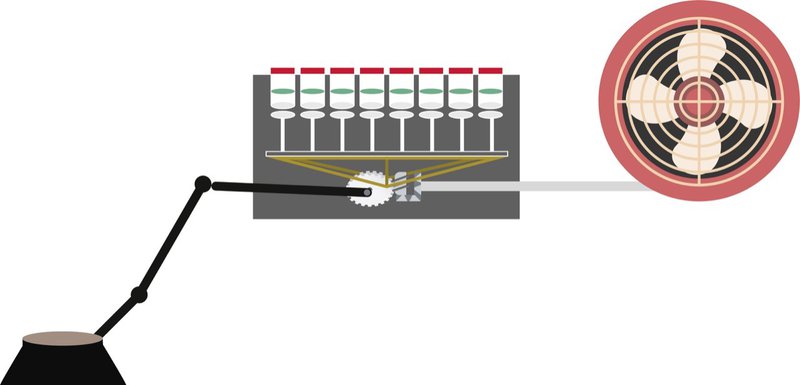
The system for capturing impulses by wind or seismic activity is composed of a series of intelligent mechanisms that operate automatically in response to an excitation from the environment in which it is inserted. This system can receive the requesting efforts from the environment and encodes this information in bits (0 and 1) through a gear system. The following image illustrates this system.
(Figure 1 – Mechanical Binary Encoder)
The system is composed of resonant coupled rods that rotate in a particular direction when driven by a common torque. Resonant rods transform the received torque into 8-bit binary information that is transmitted through lasers that are triggered due to the translational movement of the rod. This translation movement of the rods causes a variation in the light brightness of the LDR sensor which consequently activates or deactivates the laser.
The control of light beam emission is done through torque regulation that is damped by the resonant rod system and can activate the LDR sensor.
TORQUE INFORMATION TRANSMISSION AND CODING SYSTEM
The coding of an information type can be done through a binary basis consisting of using two statuses (represented by the numbers 0 and 1) to encode the information. This information can be transmitted through light.
The transmission of information through light is a technology that has been improved in recent years due to the advantages that can be achieved in the speed of processing of this signal and also because it is a system that exhibits less information loss.
In this project, a binary code transmission system was developed through light beams emitted by a ROVER laser from surface to space. The laser will be powered by a 9V - 18V battery. The main information transmitted will be given regarding the planet's atmosphere and its seismic activity. The following figure illustrates this type of system.
(Figure 2 – Lasers Activation System as a function os received pulses)
In order for the binary information transmission system to function properly, there must be a harmony between sender and receiver to avoid data loss along the way.
One of the biggest challenges of transmitting information in the form of light is that in very dense atmospheres such as Venus, light begins to diffuse from the surface.
Faced with this problem, our solution shows a way to mitigate data loss through the atmosphere of Venus by implanting a small telescope attached to a satellite orbiting the planet. The following figure illustrates what this process would look like.
(Figure 3 – Venus orbiting telescope receiving ROVER information on planet surface through light beams).
•ADVENTAGES
•The ability to operate in extreme environments (high pressure and temperature) without interfering with its service life.;
•It can store information for a long time;
The system has a high energy efficiency; without significant data loss.
•DISADVANTAGES
•Limited data storage capacity;
•The system makes use of gear combinations that impact the weight of the structure, making the Rover spend much more energy during locomotive on the planet's surface.
•CONCLUSION
Therefore, in a system of capture and transmission of information that can operate in extreme environments, it is essential to use mechanical approaches that react best to the events of the environment in which it is involved. This type of system is characterized by having a longer service life compared to traditional methods of electronics and also has a high efficiency in the management of electricity. In contrast, this type of process has no advantage in processing speed compared to traditional electronic methods. Due to the low cost, mechanical data processing in line with light beam information transmission technology can be used and thus perform various spatial, industrial and underwater applications as this system can capture and transmit information in ambient environments very hostile.