
Team NUST| The Memory-Maker
Project Details
Awards & Nominations
Team NUST has received the following awards and nominations. Way to go!
The Challenge | The Memory-Maker
Mission Venus
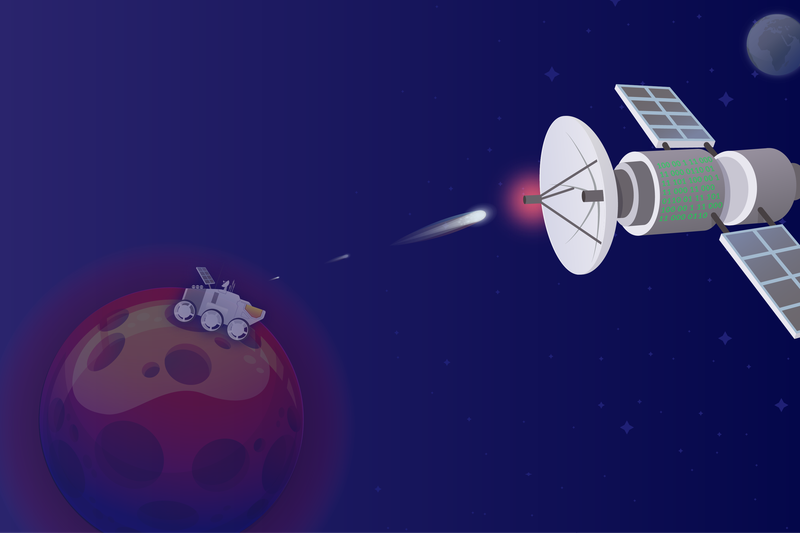
Due to the extreme environment on Venus communicating data from the surface to the spacecraft orbiting around it is one of the biggest challenges, the method proposed to overcome the limitation is by using “Modified Morse Code”.
Introduction
Venus is one of the most hostile planets in our solar system in terms of environment, with temperature reaching over 450oC and pressure up to 92 bars [1]. Although it’s called the sister planet of Earth, but life is not possible due to its extreme environment. The thick CO2 atmosphere entraps the Sun’s radiant heat and increase the surface temperature [1] to levels beyond those acceptable by the rover or spacecraft. Additionally, the dense sulfuric acid clouds [2] causes acidic rain, which damages the most environmentally sensitive part of rover - the electronics - thereby causing difficulties in data extraction and maneuvering. The harsh environment is an obstacle in Venus exploration missions and only 9 of 14 Vega Landers/Soviet Venera have landed on the surface of Venus. Even these rovers functioned for only 23 to 127 minutes before the electronics submitted to extreme environment [3]. Addition of protective layers would result in additional cost and will only delay the inevitable malfunction of electronics. This means that currently there is no method of data extraction from Venus surface, in the limited available time; data which is vital for forming models of planetary system.
Background
Records and balloons
Earlier method for making a communication from Venus was to inscribe the gathered data into phonograph style records. After that the records would be ascended in air via hydrogen balloons into the upper atmosphere of Venus where the temperature and pressure are similar to that of the Earth. The balloons and the records were then collected with high altitude drone as they were considered very feasible due to their continuous solar powered flight [4][5].
The problems that were encountered with this method included complications in tracking the path of drone and keeping it under sunlight for its continuous power. Secondly, time and location for collection of balloons was hard to calculate due to strong winds of 224 mph, making it nearly impossible to extract data. Moreover, the amount of hydrogen carried by the rover was also limited [6].
Vacuum Tube Radio
Another method to make communication was by embedding a radio inside a vacuum tube, the justification for this method is that it operates well at high temperatures. The problem encountered with this method was the complexity of the system and mass required to maintain vacuum. The other problem associated with it was the dispersion of electromagnetic waves while passing through the atmosphere.
Problem Statement
Communicating data from the surface of Venus to the spacecraft orbiting around it is one of the biggest challenges due to its extreme environmental conditions. The strong 224 mph wind along with dense atmosphere act as a barrier for data extraction. Use of high frequency electromagnetic waves is not possible due to its dispersion while travelling through the thick atmosphere [7].
Solution
Due to short wavelength of traditional data-transmitting-electromagnetic-waves, it cannot penetrate through the thick atmosphere of Venus. Therefore, the use of a low frequency (long wavelength) radio waves is required that can pass through the deep atmosphere, but the major drawback associated with it is its Low Data Signaling rate, due to low bandwidth. It can be overcome by sending data through a pulsating signal in which information is not stored in the wave but rather in the duration of each pulse.
Firstly, physical data obtained from the surface of Venus is converted into binary form, which is then converted into low frequency radio waves. Since the low frequency waves carry less data, information is converted into modified Morse code and is sent through a pulsating signal from the transceiver to the spacecraft orbiting Venus. The receiver in the spacecraft detects the pulses and decode it back to binary form.
Modified Morse code is the new proposed language for the data transmission, in which 0 from binary form is represented by a dot in modified Morse code that will be transmitted as a short pulse of low frequency radio-wave; whereas 1 (Binary form) is represented by a dash (modified Morse code) that is a longer pulse.
The transmission of data is now in the form of low frequency radio waves instead of the high frequency electromagnetic waves, thus overcoming the problem of data transmission.
Summary
Due to the extreme environment on Venus communicating data from the surface to the spacecraft orbiting around it is one of the biggest challenges, the method proposed to overcome the limitation is by using “Modified Morse Code” in which binary data is converted into a pulsating signal that will be sent through low frequency radio waves in the form of Modified Morse Code. These pulses will penetrate through the thick atmosphere and reach the spacecraft where it will be decoded back to binary form. This method can be used in exploring other exoplanets where surface conditions does not favor data extraction through traditional means.
References
- Williams, David R. (15 April 2005). "Venus Fact Sheet". NASA. Archived from the original on 4 March 2016. Retrieved 12 October 2007.
- Hashimoto, G. L.; Roos-Serote, M.; Sugita, S.; Gilmore, M. S.; Kamp, L. W.; Carlson, R. W.; Baines, K. H. (2008). "Felsic highland crust on Venus suggested by Galileo Near-Infrared Mapping Spectrometer data". Journal of Geophysical Research: Planets.
- Dyson, R., Penswick, B., Schmitz, P., and Bruder, G., “Long-Lived Venus Lander Conceptual Design: How to Keep It Cool,” 7th International Energy Conversion Engineering Conference, American Institute of Aeronautics and Astronautics
- Noll, T. E. (2004). Investigation of the Helios Prototype Aircraft Mishap. NASA. Retrieved from Helios Prototype.
- Hern, A., and agencies, “Facebook launches Aquila solar-powered drone for internet access,” The Guardian, Jul. 2015.
- Landis, G. A., “Robotic exploration of the surface and atmosphere of Venus,” Acta Astronautica, vol. 59, Oct. 2006, pp. 570–579.
- NASA. (2019). The Memory Maker. Retrieved from NASA Space App Challenge: https://2019.spaceappschallenge.org/challenges/planets-near-and-far/memory-maker/details