
Neutron| Out of This World!
Project Details
The Challenge | Out of This World!
Unmanned Aerial System (UAS) Flight App
This app is aimed to UAS pilots for off-world planetary exploration.
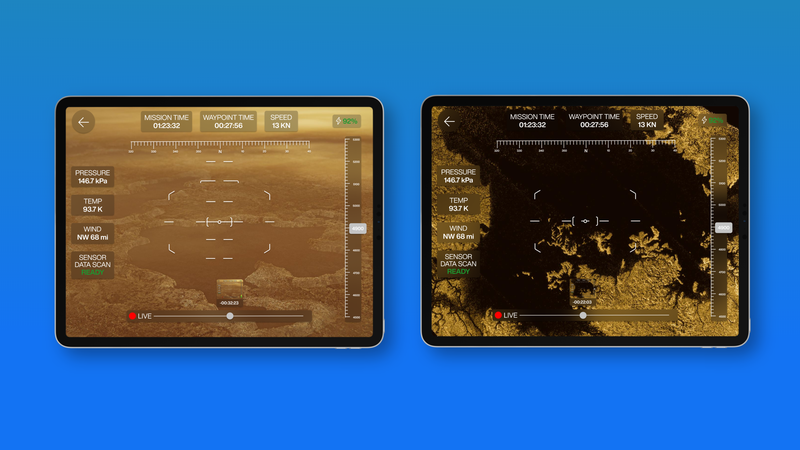
Our challenge consisted in creating an app to pilot an unmanned aerial system (UAS) utilizing the 6-axis gyro sensor within a smartphone or tablet. NASA is developing UAS for off-world planetary exploration, which flight pattern will be controlled autonomously. But what if something goes wrong during mid-flight?
Our team, Neutron, is consisted of a Social Communication student, an UX Design student and an International Relations student. None of us had a technical background, so this made us decide to approach this challenge by having the potential users and their experience as our main focus. We strongly believe that empathizing with users is key for building a good product.
This is the reason we used Design Thinking process to provide a solution-based approach to this challenge. After spending almost half of our day researching, we created a persona who had specific characteristics: they felt they needed more on-screen information, like time to next waypoint, geospatial and stream view, weather, temperature and wind data. (Gale, Jack W.; Karasinski, John A.; Hillenius, Steven R. (2018), Playbook for UAS: UX of Goal-Oriented Planning & Execution, NASA Ames Research Center; Moffett Field, CA, United States.)
But this led to our first problem. This study was for pilots who were flying in Earth. It is not the same to fly an UAS in Earth than flying in the Moon or in a different planet. With help of our mentor, César Bertucci, we figured out that exoplanet Titan had similarities with Earth. But this had a big downside: communications between Earth-Titan take around 80 minutes.
This made us realize that the main challenge had an extra difficulty: piloting an UAS utilizing an app with an 80-minute delay.
Our solution consists in planning every potential hazard that the UAS might have and, when sensors detect any of these, the UAS would land and wait for new instructions. The main purpose of the app would be using touch screen + gyroscope to plan a new waypoint, and then being able to watch a live stream (with the 80-minute delay) of the UAS path. This app would have all the visual aids that our persona requested and the friendly UI would give the pilot a better experience when flying a drone.
Resources:
Mission Cassini Research and César Bertucci, IAFE Expert, Astronomy - Space Mission Data mentoring.
Bushnell, Dennis M. (2014) Frontier Aerospace Opportunities, NASA Langley Research Center; Hampton, VA, United States.
Colozza, Anthony J. and Cataldo, Robert L. (2014), Radioisotope Stirling Engine Powered Airship for Atmospheric and Surface Exploration of Titan, Technical Report, NASA Glenn Research Center; Cleveland, OH, United States.
Fong, Terry (2018), NASA Autonomous Systems. [NASA Capability Overview], NASA Ames Research Center; Moffett Field, CA, United States.
Gale, Jack W.; Karasinski, John A.; Hillenius, Steven R. (2018), Playbook for UAS: UX of Goal-Oriented Planning & Execution, NASA Ames Research Center; Moffett Field, CA, United States.
Thompson, Maegan (2018) Project: Precise Landing on Titan, California Institute of Technology, Academic, Pasadena, CA, United States.
Trainer, M. G. et al (2018) Dragonfly: Investigating the Surface Composition of Titan, Conference Paper, NASA Goddard Space Flight Center; Greenbelt, MD, United States.
Jennings, D. E. et al (2019) Titan Surface Temperatures During the Cassini Mission, The Astrophysical Journal Letters; p.L8; (ISSN 2041-8205; e-ISSN 2041-8213); 877; American Astronomical Society.
Images Credit:
• Titan's Rimmed Lakes (Artist's Concept) - NASA/JPL-Caltech
• Seeing the World With a Drone - NASA/Andrew Carlsen
• Dust Storms Raised by Strong Winds on Titan (Artist's Concept) - NASA/ESA/IPGP/Labex UnivEarthS/University Paris Diderot
• Mercator Projection of Huygens View - ESA/NASA/JPL/University of Arizona
• Cassini Observes Sunsets on Titan Artist Rendering - NASA/JPL-Caltech