
Unicode Unicorns | Chasers of the Lost Data
Project Details
Awards & Nominations
Unicode Unicorns has received the following awards and nominations. Way to go!
The Challenge | Chasers of the Lost Data
For Your Ice Only
For Your Ice Only attempts to accurately calculate Sea Ice area in the Arctic Ocean. Microwave sensed concentration values can’t differentiate between open water and surface melt, by pulling in weather data we correct that.
Last year during the NASA Space Apps challenge we learned that it is extremely hard to calculate Sea Ice Area during the summer months. In fact, the NSIDC publishes only ice extent for its public facing ice concentration data because of this. The reason for this is that satellite microwave measurements of sea ice are unable to account for water located on ice also known as melt ponds or surface melt - both appear as water, not ice. The Unicode Unicorns set out to chase the missing data from the summer months and calculate the true Sea Ice Area in the Arctic Ocean.
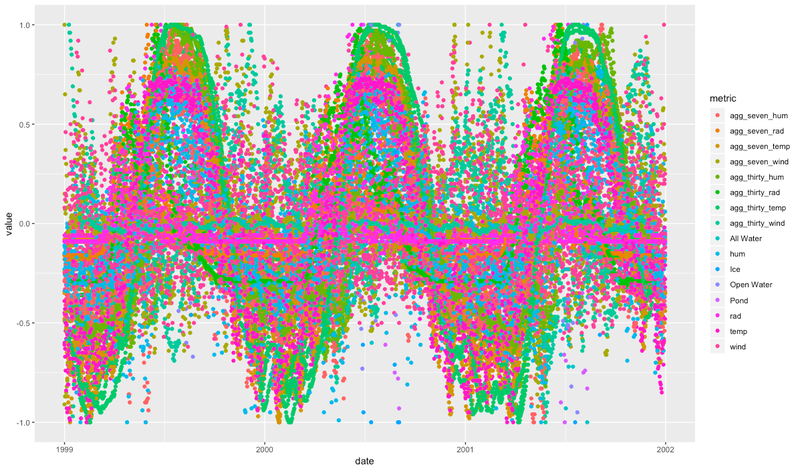
We gathered weather data from the weather api Meteomatics (https://www.meteomatics.com/en/home-en/), and paired it with processed high resolution images from the GFL (https://gfl.usgs.gov/gallery_main.shtml?current=3) that were available from the NSIDC (https://nsidc.org/data/G02159/versions/1). We calculated various aggregations of that weather data and then evaluated it's performance in predicting open water using step-wise linear regressions.
Unfortunately, the availability of this image data (LIDPs/IDPs) is very limited. We concur with the advocacy from Ron Kwok of the NASA JPL (https://doi.org/10.1016/j.rse.2013.11.015) for the capture and processing of more of these high-resolution images in the Arctic. With additional sample, these models can reach greater accuracy for use in the correction of sea ice area measurements in past data.
As a next step, the Unicode Unicorns are highly interested in supporting the process of evaluating the high resolution photography. While climatologists have exceptional grasp of the physics of these complex systems, and the deterministic predictions of weather, machine learning can be a valuable tool to support the creation of these data points.