
X Team| Chasers of the Lost Data
Project Details
The Challenge | Chasers of the Lost Data
Blank Sweeper
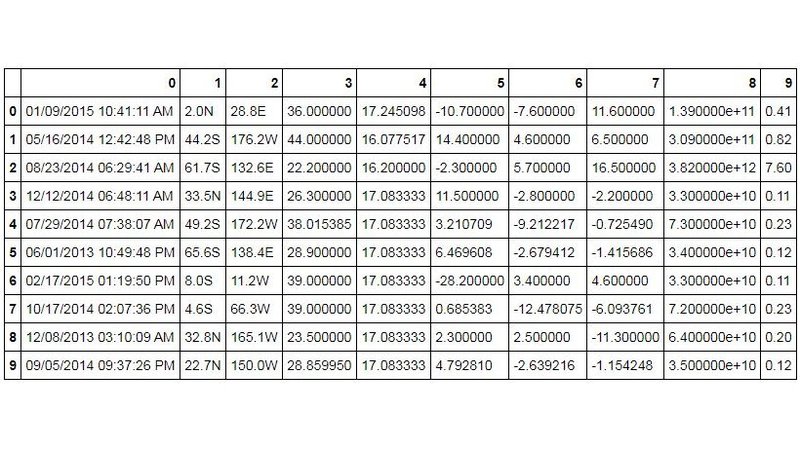
Filling out blank data in incomplete form.
Problem Statement
Find a way using machine learning algorithm to fill in gaps in datasets prior to model training in order to improve the completeness of data obtained by the sensors
Initial Approaches
Use Python, an open sourced programming language, to fulfill machine learning which assist us to form the correlations among the given data. (We should simply describe which method we’ve used ) In addition, we've made an Graphical User Interface (GUI), abstracting the code in order to simplify the operation, which make it more convenient for user. User selects the type of data, the program will choose an appropriate method(solution) , and apply it to find the missing data more effectively and efficiently.
GitHub
https://github.com/beicoles/blank_sweeper
Resources Used
Data :
Fireball And Bolide Reports
https://catalog.data.gov/dataset/fireball-and-bolide-reports
Programming :
- Language
Python 3.6, Java 1.8.0_231
- Package Environment
Anaconda3
- Libraries used
pandas, numpy, dateutil, sklearn, impyute
- IDE
Notebooks - Jupyter Notebooks
- Future steps
More filling algorithms
Team Member
Tzu-Cheng, Hsueh
Yu-Yu, Hsiao
Chi-Jhih, Li
You-Sheng, Tsao
Shih-Yang, Ko