
Dumont Team| Fly-by-Wireless
Project Details
Awards & Nominations
Dumont Team has received the following awards and nominations. Way to go!
The Challenge | Fly-by-Wireless
GRAPHEN-01
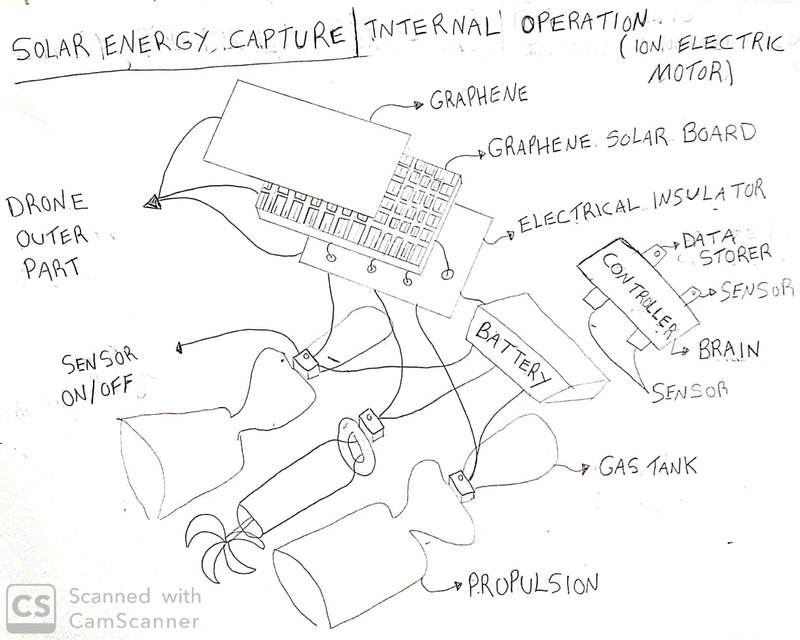
The solution found was, to create a drone made mainly with graphene and moved by solar energy.
The team's challenge, named "Dumont Team" in honor of Santos Dumont, calls for competitors to design an aircraft based on an existing model, but in its composition to reduce the number of aircraft to zero. wires, plugs and connectors.
So it was designed a Drone that uses only seven wires. We used as model two NASA aircraft the PRANDTL-M and the X-56A Flight.
In its composition, the solution to the problem of wires was found by replacing sensors (frequency transmitters and receivers), thus, the commands sent would be interpreted between the aircraft efficiently. By capturing energy through solar plates, we could supply a battery, which together with a hydrogen tank, would have enough energy to make the (electric) propellers work. Not just the thrusters, but all their electrical parts.
The material to be used for its external coating would be graphene, as it is one of the strongest and lightest materials ever found is a waterproof material and up to 200 times stronger than steel. According to NASA research, it can be called "material of the future."
Another part of the challenge is related to space exploration. Just over 200 days to the launch of the MARS 2020 mission, when NASA plans to scour Mars with new technologies.
It's a mission to answer millennial questions, the main one being whether there is life potential on Mars? The mission also intends to study the history of the Red Planet, looking for signs of past microbial life. In addition to looking to the future, gathering information for human expeditions to our neighbor.
The drone's primary function would be to assist in space missions on Mars, an alternative that may perhaps offer Martian surface mapping as it is designed to withstand sandstorms and low temperatures. In addition, the design was designed to be fully modifiable inside so that it could adapt to various atmospheres and environments, including water submersion. Our challenge is to fly wireless. We want to create a drone made of solar-powered graphene. The purpose is to register and inform. The unmanned drone will be controlled remotely.