
Project Details
The Challenge | Orbital Scrap Metal — The Video Game
//Scrapfisher//
We developed a videogame prototype dedicated to raising awareness about space debris based on real data obtained from the Space Birds app and physics skills.
Why do we choose this challenge?
We understood that the problem of space debris is a matter of rigor which must be dealt with shortly and on which, in our opinion, no specific policies are being carried out in order to solve it. The amount of space debris increases year by year because of the frequency with which objects are sent to space and this will continue to increase even if it is stopped due to the possible collision of those already in orbit.
Goals
In addition to meeting the objectives proposed by the challenge, we consider that the development of the video game is based on solutions whose feasibility of realization is the focus of discussion today.
Development
As a starting point to carry out the video game, we worked on data obtained through the NASA SPACEBIRDS platform, which were the speed at which they travel, how far from the earth they are and their continuity, seeking show them on screen to the user. The videogame is based on the player's control of a space garbage collection satellite, which will operate in the range of orbits LEO (low Earth orbit). We decided to place its development in this orbit given that more than 70% of the local space debris is in it and it is cheaper to send satellites there compared to, for example, orbit GEO. The objective will be to collect small objects. From 101 mm. (4 in.) Objects begin to be detected by United States Space Surveillance Agency and therefore, know their location in real time.
Aware that at present the only way to move through space is by means of mass impulse. Our ship will eject a part of the collected particles, to be able to stay in orbit and move to other superiors. If necessary, propel themselves to lower orbits, it will have a system that does not require this type of propulsion since the particles would move away from the atmosphere and would not be incinerated. It will be assumed that all satellite systems will be powered by solar energy. It will take into account the fact that being in the same orbit as another object, the distance between it and our satellite will not vary because they will be traveling at the same speed. In order to exemplify and insentivate users to think about projects with an economic purpose that serve as a solution to the problem, the rest of the mass collected will be used as raw material in a venture to sell shooting stars on demand, which will be a product to propel the charge into the atmosphere and be incinerated by it, generating the desired beam of light.
The physics of the problem
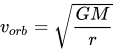
We will simplify the real model considering that the orbits through which the garbage and our satellite move will be circular and contained in the same plane. This will make the velocity of movement on it constant for a radius r taken from the center of mass of the Earth and this will be described by the following equation:ecuación:
Our satellite will have a solidarity reference system associated with it. On which we will position ourselves to be able to observe the relative movements of objects that orbit at a greater or lesser height with respect to this.
The speed at which space debris travels will be obtained from the SpaceBirds app, as well as the distance they are from the Earth’s surface.
We will seek to show the relative distance D between the particles and our satellite to provide a predictive tool to the user, for this a representative distance that gives the user enough time to make decisions is calculated:
- The angular velocity is calculated

- A time window is defined Δt for which the display of objects is desired, from when the user is notified until they align with the ship.
- By multiplying angular velocityω for the interval of time Δt we noticed that ΔΦ It is very small, therefore we can approximate Δs (Arc length) as r*ΔΦ where r = radio y ΔΦ = Angle variation Φ (defined as the angle formed between satellite-Earth-scrap system).
- In this way we already have a leg of the rectangular triangle formed by the satellite, scrap and the projection of the first on the orbit of the second. We obtain the second leg with the difference of orbital heights Δr and by Pythagoras we obtain the desired distance D.
Scrapfisher
Introduction
Control your satellite space debris collector through low Earth orbit. Collect as much as you can and transform it into luminous shooting stars. Earn money and make your venture grow.
The game
After a mysterious message of the future was transmitted through the screen of your computer, you decide to create a revolutionary and innovative business to take advantage of space debris and avoid a catastrophic destination. Travel from orbit to orbit, sell your waste collection services and "deliver" shooting stars to your home. Earn money and invest it in your startup so that it grows and uses part of the collected material to propel your ship. Be careful, if you do not meet your deliveries on time there will be no pay and if you do not collect enough, you can run out of fuel. The challenges will begin with a call that may refer to the cleaning of an orbit or the commission of a shooting star in a particular place, which will be the product of the collection of orbital garbage and its consequent projection and incineration in the atmosphere.
Mockup

Main Menu

Prototypes of the space debris satellite
Collecting mechanism
Decapping of collecting capsule
General view, with deployment of energy supply mechanism
Project Estructure
Project Modules
Data Logic Model
About Us
| Information | Image | |
| Name | Cunha de Meira, Katylin Rainara | |
| Age | 22 | |
| Birthplace | São Roque, São Paulo, Brasil | |
| Career | Mechanical Engineering | |
| Why did you sign up? | I love teamwork and learning |
| Information | Image | |
| Name | Custodio, Walter | |
| Age | 25 | |
| Birthplace | La Plata, Argentina | |
| Career | Multimedia Design | |
| Why did you sign up? | Personal challenge |
| Information | Image | |
| Name | Daruich, Valentina | |
| Age | 26 | |
| Birthplace | Tres Arroyos, Argentina | |
| Career | Multimedia Design | |
| Why did you sign up? | At the invitation of a partner. |
| Information | Image | |
| Name | Difeo, Martin | |
| Age | 22 | |
| Birthplace | La Plata, Argentina | |
| Career | Visual Arts/Scenography Design | |
| Why did you sign up? | A friend's invitation made me curious to come. |
| Information | Image | |
| Name | Hernández Mejía, Carlos Alejandro | |
| Age | 21 | |
| Birthplace | El Salvador, Centro América | |
| Career | Computer Engineering | |
| Why did you sign up? | Why not come? |
| Information | Image | |
| Name | Lacava, Tomas | |
| Age | 25 | |
| Birthplace | Chivilvoy | |
| Career | Mechanical Engineering | |
| Why did you sign up? | I was always interested in space and programming, and the SpaceAppsChallenge is a good mix of both. |
| Information | Image | |
| Name | Marengo, Augusto | |
| Age | 25 | |
| Birthplace | Trenque Lauquen | |
| Career | Mechanical Engineering | |
| Why did you sign up? | The event caught my attention and I really like collaborative challenges. |
| Information | Image | |
| Name | Salto, Emanuel | |
| Age | 25 | |
| Birthplace | La Plata, Argentina | |
| Career | Mechanical Engineering | |
| Why did you sign up? | I wanted to use my head and left the challenge to luck with a coin. |
| Information | Image | |
| Name | Ortiz, Gabriel | |
| Age | 35 | |
| Birthplace | Berazategui, Argentina | |
| Career | Degree in Computer Science | |
| Why did you sign up? | Search for new challenges. |
"The space surrounding the Earth is a natural resource that must be preserved"
Reference material
More Information about the project
https://github.com/JandroMejia97/ShootingStarMaker
Read the game manual of the game video https://github.com/JandroMejia97/ShootingStarMaker/blob/master/MANUAL.md
Nasa Spacebirds https://worldwind.arc.nasa.gov/spacebirds/index.html#
Article on space junk from the NASA Headquarters Library https://www.nasa.gov/centers/hq/library/find/bibliographies/space_debris
Article published by NASA about space debris and human spaceships https://www.nasa.gov/mission_pages/station/news/orbital_debris.html
The design of the prototype and the system have been of own elaboration. © All rights reserved.