
Project Details
The Challenge | Orbital Scrap Metal — The Video Game
Spake
Game similar to the old-school Snake, but in space!
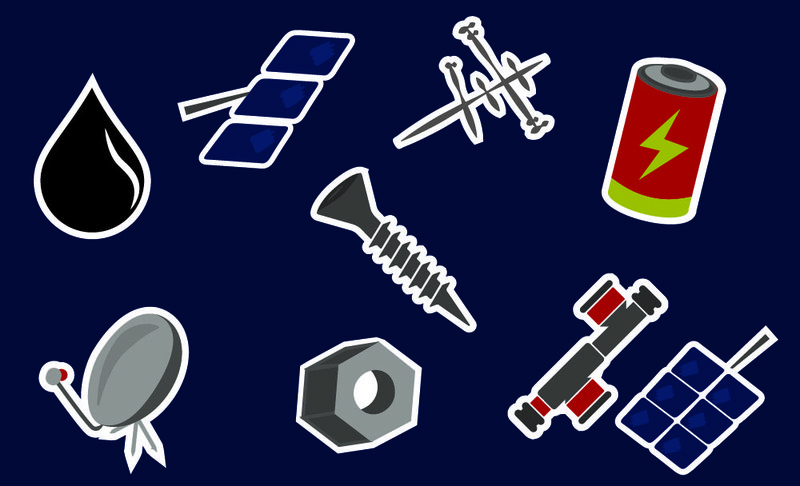
The main goal of our project [1] is to raise awareness about the high number of debris floating around Earth and the threat they pose both to space infrastructure and to human lives. They can be defunct satellites, damaged space probes, lost equipment, boosters or rocket stages.
The intensely debated and hypothesized Kessler Syndrome is a chain reaction of collision that increases the amount of debris and would be unstoppable after a critical density.
What better way to teach people about sustainable space exploration than in a game-like scenarios where people can compete in cleaning up space!
The most memorable event that resulted into space debris took place in February 2009, when two artificial satellites, Iridium 33 and Kosmos-2251, accidentally collided at a speed of 11,700 m/s and an altitude of 789 kilometres above the Taymyr Peninsula in Siberia. This resulted into countless debris that ended up orbiting Earth with no immediate solution to dispose of them.
The game encourages the player to collect as many accurately placed debris above a continent of their choice.
Our idea was to start the game by allowing the user to choose a continent above which to float. We would then parse the TLE data [2] for both Iridium and Cosmos debris, select the debris placed on top of the selected area and render them on the screen one by one, as soon as they are collected.
The ship starts off with a certain amount of fuel available which depletes over time, however the collected debris can be recycled, scraped and exchanged into more fuel! We would keep track of the number of debris collected and inform the player at the end of the game the contribution they had to cleaning the space around Earth. Different mechanisms to clean debris would be implemented like: remotely controlled probes,laser methods, nets or harpoon.
[1] : Project on Github: https://github.com/mirelonni/space_apps_2019
[2] : TLE data: https://www.celestrak.com/NORAD/elements/