
Sailorsss| Internet on the Ocean
Project Details
Awards & Nominations
Sailorsss has received the following awards and nominations. Way to go!
The Challenge | Internet on the Ocean
INTERNET ON THE OCEAN
KEEP THE SAILORS CONNECTED
ABOUT US
Athanasleri Despina Age 22 IT Engineering
Chorafas Ilias Age 22 IT Engineering
Saltsoglou Thanasis Age 27 Geology
SECTION 1: THE CURRENT SITUATION.
The problem of internet connectivity on the ocean is well known amongst a ship crew. The method currently used to gain access to the internet is satellite connection using very expensive hardware (approximately 5.000 to - 60.000 US dollars) and paying 1$ - 20$ for every MB of use, depending on the plan. This type of connection is mostly suitable for emails, weather data collection and emergency browsing.
SECTION 2: WHAT IS SAILORS NETWORK?
Sailors Network is a system that provides a cheaper, faster, unlimited and with much more amenities internet connection on the ocean’s surface. It is composed of antennas on the top of every vessel creating a mesh network. The idea of this network is to keep every ship connected with coasts and each other. The ships will now carry the internet, like they already do with their cargo, as they are going to be repeaters and enabling the point-to-point (ship-to-ship) communication giving the crew the ability to keep being connected with the rest of the world.
We are going to need:
- Two directional antennas for every ship
- Ships
- An internet provider at the coast
SECTION 3: HOW THIS WORKS?
Observing marine traffic anyone can see two things. First, ships are moving around certain areas in order to reach their destination. Second, ships along their paths are coming across with other ships in a maximum distance of 30km. So, we chose a mesh network because it can be dynamically reconfigured. This enables the network to continue working when one of the transceivers goes out of range, with almost no downtime. This capability is extremely important when working in such challenging environments like the ocean. It also requires low setup costs and allows for easy expansion and servicing.
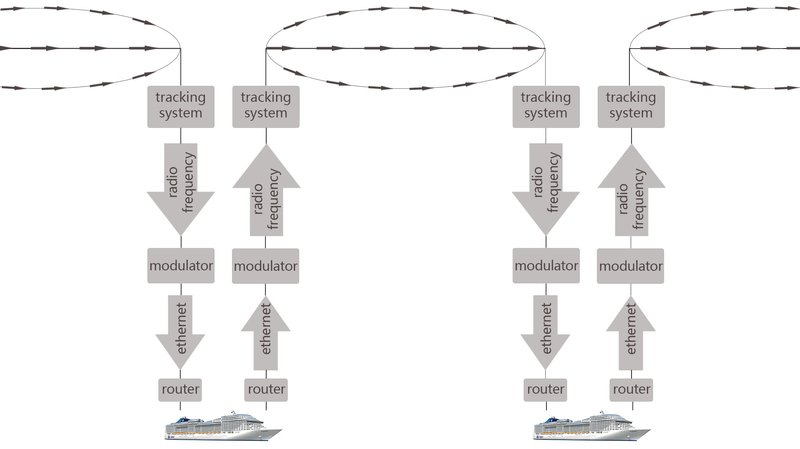
Every ship will have two directional antennas, these antennas will transmit and recieve on a 5-5.8GHz radiofrequency, one will search for the nearest antenna at the vicinity of approximately 50 km to get the internet and the other antenna will be pointing at the direction on which the signal will be moving on. This will be achieved with a tracking system, to take the exact location of the nearby ships (those within the zone and with the strongest signal in the area) we are going to use a marine traffic map from the internet (e.g. https://www.marinetraffic.com/), this way a ship will both receive and transmit from and to the nearest ships each time.
Using a modulator, the received signal will be converted from a wireless protocol that allows signal reconstruction (e.g. VOFDM) into ethernet protocol and reverse. After the modulation stage the transmitted signal will be converted into radiofrequency and the received signal through an Ethernet port that we are going to connect a router it will provide Wi-Fi connection to the entire ship.
It’s worth mentioning that every ship will have to carry both of these antennas at the bridge of the ship in order to avoid the transmitted signal crash on the water surface and reflects back using water as a mirror. Considering Fresnel Zone Radius this is easy to happen. The formula for determining the radius of the widest point of the Fresnel zone (in meters) is: 17.32 * where d is the distance (in kilometers) between the two antennas and f is the frequency (in GHz) at which you are transmitting.
SECTION 4: WHY INTERNET CONNECTION ON THE OCEAN IS SO IMPORTANT?
Sailors spent most of their days in the middle of the ocean, not being able to communicate with their loved ones, losing the most important moments of their families (birthdays, Christmas and other special days). Internet helps them to keep in touch with their families and the rest of the world and be informed about the latest news around the world and their hometown. Entertainment is also a good reason, keeping your employees happy makes them more productive.
Internet connection can also be used for any type of emergencies, for example, medical emergencies. In ships where there is no doctor in the crew, they can take medical instructions until medical help is available.
Last but not least, creating an internet network on the ocean gives the scientific community the great opportunity to make real time measurements and research with the help of IoT.
Sources:
- [online] https://en.wikipedia.org/wiki/Mesh_networking [visited 17/10/2019]
- [online] https://www.marinetraffic.com/en/ais/home/centerx:... [visited 17/10/2019]
- [online] http://www.globalmarinenet.com/wp-content/uploads/... [visited 17/10/2019]
- [online] https://en.wikipedia.org/wiki/Modulation [visited 17/10/2019]
- [online] https://dsp.stackexchange.com/questions/38025/vofd... [visited 17/10/2019]
- [online] http://www.globalmarinenet.com/satellite-internet-... [visited 17/10/2019]
- Sailor image on the video https://it.cleanpng.com/cleanpng-tfreht/download-png.html [visited 25/10/2019]