
The 3 Hacketers| Internet on the Ocean
Project Details
The Challenge | Internet on the Ocean
Maritime Xpress
MX provides economic internet for people located far away on the ocean.
Background Information:
Although the internet is available at a very low price on land, boats and ships in the ocean are having difficulties to access to it. One available option for them to choose is using satellite internet, which is expensive because of the needed equipment to be installed before using. Therefore, we want to come up with a way to allow users on the ocean to use the internet at an affordable price.
Our Process:
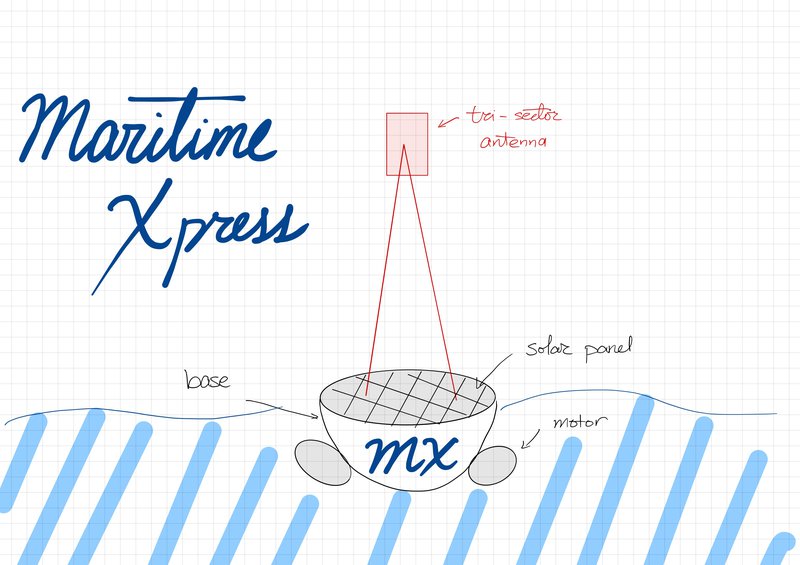
We discussed and brainstorm to solve this problem with many different approaches. One of them we came up is to make use of the submarine communication cables to provide the network and power. However, we find out that it is also impossible to retrieve network by a cable that is placed deep beneath the ocean surface. On the other hand, using cables to supply power is not realistic as well, since the cables are not spread all over the ocean but usually in a dense area. In the end, we decided to use cell towers to deliver internet and solar panels as the power generators.
Our Design:
We call our solution Maritime Xpress. We decided to build floating cell tower islands, placed them all over the ocean, and use them to provide the internet. Every floating cell tower island is an AUV and can use motors to move in the water. They are placed like the cellular radio towers on land. If an island left its original position, which might break the internet connection, it will redirect itself back to its original position. On the other hand, if there is a storm approaching, the island can leave its position and come back after the storm. This way, we can reduce the damage of the weather to the lowest.
Energy Saving:
Because the internet usage on the ocean is not as dense as it is on land, not all cell towers are needed at a certain time. Since electricity is hard to obtain on the ocean, we came up with a way to reduce the energy consumption to the minimum. Only when the floating cell tower island is needed, then it will be woken up. If a boat is leaving coverage of cell tower island A and moving toward cell tower island B, island A will inform island B to wake up and it will go to sleep once the boat leaves the area it covers.
Summary:
Because the current cost of the internet on the ocean is extremely expensive, sailors and other ocean travelers are not able to contact their families and do not know about what is going on around the world. Although it is probably fine to have no access to the internet for a short time, like one or two days. But for them, it might be months before they can connect those who they love. We hope, with the help of our ideas, the internet can be accessible for these people as well and are no longer a privilege of others.
Our PowerPoint Presentation:
https://drive.google.com/file/d/1k6-6Cobo-ZWpu7Y2r...
Reference:
https://news.energysage.com/how-much-does-the-average-solar-panel-installation-cost-in-the-u-s/
https://www.sciencedirect.com/science/article/pii/B9780128130643000119
https://en.wikipedia.org/wiki/Cell_site
https://www.steelintheair.com/building-your-own-cell-tower-checklist/