
Project Details
The Challenge | Invent Your Own Challenge
dbT18
Space Debris Removal Satellite
We all know that space debris is very dangerous, because colliding with a satellite can destroy the satellite and create new space junk or major damage to the satellite, and that could make a damage worth millions of dollars (50 to 400 million dollars).
At this moment there is a large number of active satellites in space, including the ISS, so the space debris is a constant threat to it. It is currently a highly managed risk and it must be constantly monitored.
According to the data, in January, more than 129 million pieces of various sizes of space debris circulate around the Earth, and they are from less than 1cm to over 10cm and there are also dead satellites. So if you want a exact number, that is a incredible 138 million cm, or 1380 km of space debris.
Space debris is within a radius of 2000 km from the Earth's surface, and the highest concentration of junk is at 800-850 km from the Earth's surface, or more precisely it is in the Low Earth Orbit (LEO), where this satellite will be launched.
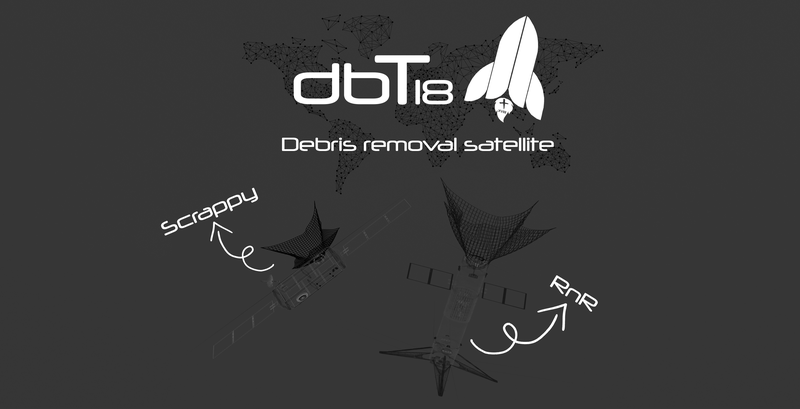
dbT18's first spacecraft (Scrappy) receives information about where the space junk is located, and there is a locator that detects the new ones and collect them.
Some of the junk is moving at speed up to five times faster than the bullet, but the satellite will be able to adapt to it easily and collect the junk.
Then the debris from the space together with the cargo or second aircraft (RnR) will land to the ground.
While some things in the world seem impossible at first glance, we still have to admit that billions of dollars are spent to make a film with world-saving theme, and in fact no one wants to spend that money to truly save it, but here's an opportunity to do that.