
Galactic Pigeon - The Past is Coming| 1UP for NASA Earth
Project Details
The Challenge | 1UP for NASA Earth
Galactic Pigeon - The Past is Coming
Enlighten the past for a Brighter Future! GP shows students that data collection and analysis is a powerful tools for creating a better future, picturing NASA Worldview and The GLOBAL Program as meaningful platforms in this endeavor.
The Problem
In the technology age, we live in a data-driven world. Analyzing recent data helps humanity foreseeing and stopping what could become hazardous catastrophes. And enlightening past data prevents us from insisting on the same old mistakes.
NASA Worldview empowers every person with the capability of learning from a complete database that comprises a myriad of statistical Earth's information, providing a way to get even closer to the world we live in. There is also the GLOBAL Observer App, which turns any interested citizen into a "Scientist" who can make the difference by providing local data regarding land cover, trees, clouds, and more, fighting problems that range from dangerous decreases in biodiversity to possible mosquito outbreaks.
However, most students don't know about the massive importance that scientific data has for our society or even know about NASA Worldview or The GLOBAL Program. In fact, out of the 50 students from 10 different countries that participated in our search, no one had ever heard about any of those magnificent platforms - Fortunately, many seemed to be interested to know more about, though.
If today's, the main characters of the future, do not value data as they should and don't know about platforms that can help them to better comprehend the world they live in, humankind you surely end up losing something. But we are here to change this scenario!
Our Mission
First of all, we are going to show students why and how data is essential for building a better and more sustainable future. After playing Galactic Pigeon, they will comprehend that only through knowing the past harmful events we can design a future without them.
Moreover, our game is going to be an immersive and fun way to learn more about geography and history, helping students to unconsciously absorb academic information and fun-facts while playing. In the meanwhile, Galactic Pigeon is going to promote NASA Worldview as a powerful tool for those who seek a better understanding of our world in a Physical and Environmental perspective, as well as Earth's changes alongside time - and their probable causes.
And what is more: players will finish Galactic Pigeon knowing that they are too part of the data world, being able to act as agents of change. We aim to inspire these students to pursue helping humanity with scientific and environmental data collection, be it by becoming Citizen Scientists trough The GLOBAL Program or starting new meaningful projects. We yearn to inspire them to become data-heroes for a world deeply in need!
Our Method
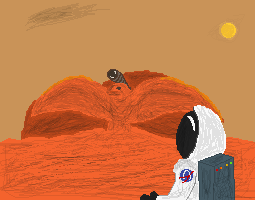
Galactic Pigeon is an immersive and fun game that despite aiming for young teenagers, was designed to entertain kids and adults as well. The game takes place in a futuristic scenario (the year of 2100) in which NASA just observed a distinguished form on Mars. The player, a special astronaut, is sent to investigate it and getting there, discovers that the strange form is actually a bird-shaped observatory.
A further look shows that this observatory, the Galactic Pigeon, was built millions of years ago by Clark, an ageless, ingenious, and gentile alien whose planet was destructed by the actions of his people, who underestimated the importance of data collection and analysis, constantly repeating the previous mistakes, exhausting natural resources and polluting the environment, culminating in irreparable damage.
Clark had set out to prevent other inhabitable planets of falling for the same reasons. He observed Earth for hundreds of thousands of years, naming his Mars observatory as Galactic Pigeon because similarly to its Earthly counterparts, it would bring an important message: Earth's natural and anthropological histories. However, with time, Galactic Pigeons's collected data got all mixed up. For a better insight, please check out our game's intro! It's simple, but may help you to get the real feeling.
Now, it's the player's mission to reorganize Galactic Pigeon's data in order to enlighten the pas for discovering the path for a better future. For this purpose, the astronaut has to complete diverse mission sets. Completing a mission means unlocking more data, which can be new intervals of time, different measures or so on. The first mission is based on real data from the Global Observer App. The player has a specific description of a local's vegetable landscape seem from the different cardinal points and, through seeing images of all the available options, the astronaut must determine from which the description belongs. This allows students to have an immersive contact with technical geographical definitions, enhancing their learning. Besides this, the player will have a taste of what it is like to be a Citizen Scientist, being inactivated to follow this path.
Upon completing this first mission, the astronaut is going to unlock the years of 2100 to 2095 (history's present days until 5 years before) and the second mission is to look into a specific spot during this whole time interval, in a similar system than that of GLOBAL Observer App, and identify if there is any abnormality happening, like biodiversity decrease, land uncovering, fire, melting, or a mosquito outbreak. In any of those cases, the astronaut must send an alert to Earth's government. But caution is essential here: for succeeding on this mission, it's necessary to identify all and only the real alerts - in other words, false alarms will also result in failure. Hence, the player will see first-hand how data collection is useful for building the so-called better future, avoiding past failures, and preventing possible catastrophes.
After completing this second mission, the third mission (and the last of our beta version) becomes available. A sample of data regarding from 130.000 to 90.000 years ago is unlocked and the user can clearly spot a decrease in Earth's temperature due to the blueish tone on the planet's colors, in a similar way NASA Worldview does. The astronaut's task now is to identify what was happening there, choosing the right answer from a pool of options. This mission brings the moral value of looking for data collecting as a bridge between past and future, bringing the message of "what today's world would be if we had NASA Worldview since hundreds of years ago? How many mysteries would have been solved? How much more developed would our technology be?" Dragging along the realization that today's world will, someday, become the ancient past, and the data we have now will help future civilizations to have a better comprehension of or societies.
Aiming to highlight the player's capability to be a great agent of change, providing incentive for joining the fight for data collection and analysis, all Galactic Pigeon's in-game scenes are in the first-person style, immersing the player into the astronaut's character, picturing him or her as a true hero who carries the responsibility to understand the past to bring forth a more sustainable future!
Please, check out our code here!
Next Steps
We have a mission that we wish to accomplish. Thus, we are going to have a lot of hard work to do after the competition. As due to technical complications we started to develop by Saturday a 10:00 p.m, we could just finish a Minimum Viable Product.
The first, and biggest, difference that we plan for the final version is updating the whole game (user interface, code, and graphics) for a Virtual Reality environment. This was our initial plan, but we knew that if we focused on the VR implementation now, it would not be possible to show our complete value proposition in the other parts of the game. Thus, we made it in the first-person style aiming for giving an aim towards its VR final version. For this purpose, and also due to the fact Python won't work for cellphone games (hence making the game less accessible, which goes against our purpose), we are going to make a whole new 3D version with Unity Engine.
Afterwards, we are going to increase our mission database, including many more options of each of our mission types (near past (2019), present, and further past) and set two game distinct modes: The Casual, in which missions are going to be easier and the language simple, being ideal for kids. And the Serious Play Mode that will provide the player with challenging missions that will require a cleverness to solve, besides connecting the knowledge in different areas (some given by the game and others that will require external research or previous knowing).
For the Near Past missions (those that deal with nowadays real GLOBAL Observer App database), we plan to increase our usage real data. For our MVP we managed to use data from one real spot but in the actual game we pretend to have all of them, truly linking the game with GLOBAL Observer App.
Regarding Further Past missions, we plan on launching challenges ranging from discovering a massive volcanic eruption to spotting the cause of the plague in medieval Europe, so players may learn about Geography, Sciences, and History while having fun.
At last, but not least, as our main mission is to massivele divulgue the importance of data and provide a fun and effective study tool, Galactic Pigeon will come absolutely for free.
The Team
Years ago, before we met, the three of us set as our mission, each one for his personal purposes, to use technology as a tool for enhancing our society and fixing the world's problems. Our journey is only in its beginning as we are still in high school. However, we know that our goal is not "kids' play" - such an ambitious objective requires an equivalent dedication. Thus, we are constantly struggling to improve ourselves, aiming for excellence in academic and personal spheres.
Together, we sum up to 9 approvals for summer camps at some of the world's best universities, like Yale and Stanford, in subjects ranging from Game Design to Sustainable Development and Social Entrepreneurship. Also, we won about 40 medals at national and state-level academic Olympiads. Moreover, our startup Easy2Pet was the only High School startup to place among the 12 finalists of Microsoft's Imagine Cup in 2019, besides being selected to expose at Europe's biggest technology fair, WebSummit, and Startup 100. Further, we were graced with our state's Memorandum of Understanding, in which they declare Easy2Pet essential for our society's well-being.
Education opened many doors for us - actually, it was what brought us together. So, we looked for a challenge that we could use to educate people, and 1 Up for NASA Earth called our attention because we knew that most teenagers live in "bubbles" and don't know exactly what is going on outside their homes. Also, most students in our country (Brazil) don't like STEM and data analysis in general. Thus, our objective for NASA Space Apps Challenge became clear: to educate, for both, general academics and data analysis.
As I said, our journey is only beginning: we still have to walk through a long - if not endless - road until we reach our personal excellence. And this competition is one more way for us to challenge ourselves, put in practice what we have learned, and enhance our skills. Thus, we leave one last message for any teenager that happens to read this: if any contest calls your attention, try it out, even if the chances of winning seem to be low. Because the best of all awards you are going to receive: one more history to tell, and one more experience to base your future endeavors on.
Overview
In short, Galactic Pigeon is a game that shows the players that data is alive, constantly changing, besides possessing an endless capability of improving humanity. Our goal is to make players comprehend they are more than mere coagulants in our data-driven world, picturing NASA's Satellite and On-Ground data as powerful tools for those who intend to acquire and share information about the Earth we live in!