
A1 - Cosmos| Smash your SDGs!
Project Details
The Challenge | Smash your SDGs!
Audio 1
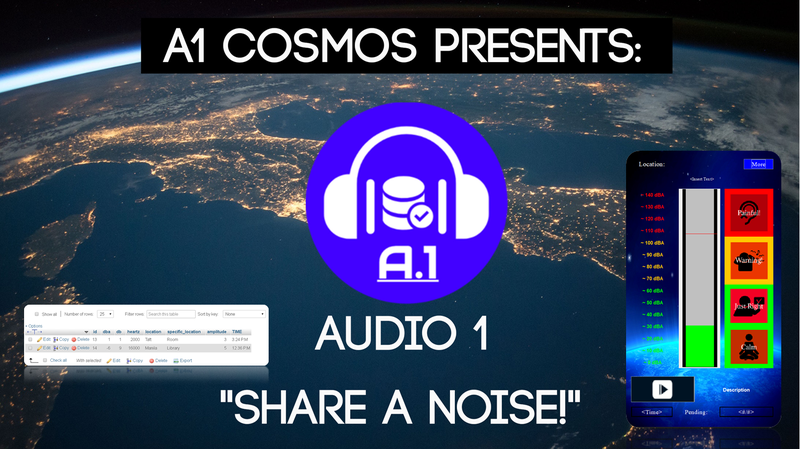
A1-Cosmos aims to develop a mobile application that would create a noise quality surface that displays that most accurate data location and time. However, a large, real-time, noise data should be collected first.
Our Challenge:
A1 - Cosmos is tackling the SMASH YOUR SDGs! challenge under the LIVING IN OUR WORLD category. Emphasis on United Nation's Sustainable Development Goals, SGD 3: GOOD HEALTH AND WELL BEING , SDG 11: SUSTAINABLE CITIES AND COMMUNITIES , and SDG 14: LIFE BELOW WATER.
The Problem:
Noise pollution (generalized as “noise”) poses a threat to sustainable development due to its adverse effects to our health and well-being as well as our progress towards achieving sustainable development. The concept of noise, however, is varied due to it being a subjective term. Different people may respond differently to the same level of noise. But above certain levels, noise can affect everybody (Anonymous, 2019).
Solution:
Create a practical mobile application to measure noise and other pertinent data, and submit results to NASA’s-Anecdata website.
Background:
There are existing tools and mobile application that record and measure noise. The most complete among these are Decibel-X. Another tool that is available for gathering noise is the Decibel Maker, a scientific manual apparatus that records sound in the surrounding environment. Below is the trade-offs between the two.
Comparison of Decibel-X and the Decibel Meter:
| Criteria | Decibel-X Mobile Application | Decibel Meter |
Cost / Price Range | 90 - 310 Php | 600 - 1500 Php |
Range of Measurement | 30 - 130 dBA | 30 - 130 dBA |
Details | Exists as a mobile application with a fee and can be used if you have a smartphone. | Scientific apparatus specifically for measuring noise and has limited availability. |
The overall aim of the project is to obtain relevant data pertaining to noise through the use of crowd-sourcing. The said data will be a collective amalgamation of all the data that has been gathered by the users of the application. The application will utilize the mobile phone’s built-in recorder that records the sound within the user’s environment and will convert it instantly into A-weighted decibels (dbA) , the unit measurement for noise. When the data has been recorded, the application will identify the address via Global Positioning System (GPS) embedded in the mobile device and will then be transferred and stored temporarily into a cloud storage. Once a collective amount of data has been gathered, it will then be transferred back into the mobile device as thermal mapping data.
Challenges Faced:
The team faced two challenges during the overall development of the project which was time constraint and lack of resources One of which was time constraint. The time allotment for the development of the project was limited and we had to make the most out of it as well as balancing rest with work. Another was the lack of data and resources to work with. We can only find minimal findings in to provide sufficient supporting details.
Methodology:
- Design interface
- Develop a prototype - We made use of Java in order to develop the application software.
- Test of prototype - This composed of compiling and debugging.
- Present Proposal - Presenting the Java source code of the project.
Next Step:
Once there are large, real-world, noise data set, we can:
- Can establish a diverse information about noise pollution
- Create a real-time heat map of noise pollution
Team Source Compilation and Source Code: https://drive.google.com/open?id=1wOj-Nkf8uRX1IH5s...
Related Literature:
Throughout the making of this project, we made use of the following resources:
- Anecdata. (2019). Retrieved from : https://www.anecdata.org/
- Decibel X: dB, dBA Noise Meter. (2019). Retrieved from : https://sensortower.com/ios/US/publisher/app/appName/448155923/category-rankings?category=6002&start_date=2019-09-20&end_date=2019-10-19&countries=PH&chart_type=free&device=iphone&device=ipad&selected_tab=charts&date=2019-10-19&summary_chart_type=topfreeapplications
- Elmqvist, T. (2013, August 25). Retrieved from: https://www.thenatureofcities.com/2013/08/25/designing-the-urban-soundscape/
- Goal 9: Industry, Innovation, Infrastructure. (2019). Retrieved from : https://www.sdgfund.org/goal-9-industry-innovation-infrastructure
- González, D. M. et al. (2018, September). Retrieved from : https://link.springer.com/article/10.1007/s40726-018-0095-7
- Guidelines on Design of Noise Barriers. (2003, January). Retrieved from : https://www.epd.gov.hk/epd/sites/default/files/epd/english/environmentinhk/noise/guide_ref/files/barrier_leaflet.pdf
- Moehring, J. (2019). Retrieved from : https://www.brighthubengineering.com/building-construction-design/64431-sound-proof-construction-techniques/
- NASA. (2019). Retrieved from : https://www.nasa.gov/
- NASA’s Lower the Boom. (2019). Retrieved from : https://www.nasa.gov/sites/default/files/atoms/files/citizen_science_guide_508_ssgl_62019.pdf
- NASA’s Open Data Portal. (2019). Retrieved from : https://data.nasa.gov/
- Noise. (2019, May 24). Retrieved from : https://www.epd.gov.hk/epd/english/environmentinhk/noise/noise_maincontent.html
- Noise Level Chart: Decibel Levels of Common Sounds with Examples. (2019). Retrieved from: https://boomspeaker.com/noise-level-chart-db-level-chart/
- Nzilano, J. L. (2018, April 30). Effects of Noise Pollution on Students’ Learning in Selected Urban Public Secondary Schools in Dar es Salaam City, Tanzania. Retrieved from : http://arjess.org/education-research/effects-of-noise-pollution-on-students-learning-in-selected-urban-public-secondary-schools-in-dar-es-salaam-city-tanzania/
- Peterson, B. (2017, June 30). Retrieved from : https://greentumble.com/how-noise-pollution-is-disrupting-the-ecosystem/
- Sen Nag, Oishimaya. (2018, September 26). What Are The Harmful Effects Of Noise Pollution? Retrieved from : https://www.worldatlas.com/articles/what-are-the-harmful-effects-of-noise-pollution.html
- Scott, E. (2019). Retrieved from : https://www.verywellmind.com/stress-and-noise-pollution-how-you-may-be-at-risk-3145041
- Walters, J. R. and Westman, J. C. (1981 , October). Retrieved from: https://www.ncbi.nlm.nih.gov/pmc/articles/PMC1568850/