
berelax| Fly-by-Wireless
Project Details
The Challenge | Fly-by-Wireless
Vanguard wireless technology to coming airplanes
Airplanes and spacecraft are ones of a few vehicules and general tecnologies that have to be at the vanguard in high technology to do safer and cheaper flights and sometimes more comfortable
Nowadays, the efficienty and optimization is a very important thing for all the industry, cause mostly for the increasing price of oil and the tendency of sustaintable development.
In aerospace industry, the principal challenge is reduce consumption of fuel by more efficiente turbines and reduce the weight of the airplane.
In this challenge, it is propose to solve the reduction of weight by wireless systems.
I propose 4 technologies:
Optical fiber [1]
Objetive: make it lighter reducing wires, applicable now
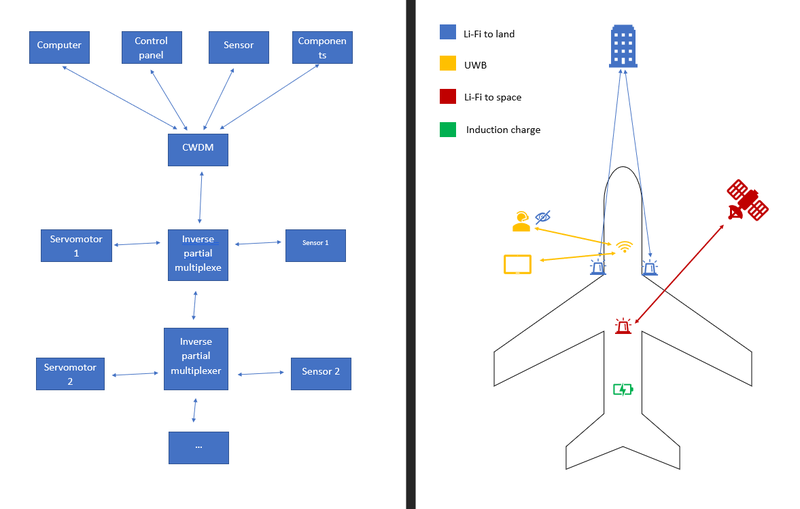
I suggest use fiber optic for internal comunication between devices, like computer, control panel, flight panel, and sensors, because we can use a single optical fiber to send and receive information from/to many devices. This is posible using multi-mode optical fiber and CWDM (Coarse Wavelength Division Multiplexing) because is cheaper, consume less energy, is relatively simple and made for short distance. In addiction, it is inmune to electromagnetic interference and can't do short circuit to cause fire on-board. Also, if it's needed one more device it's not necessary to install other wire because a single optical fiber can send and receive information of many devices, only if it is satured it's necesary a new one.
We can adapt the output of all this devices with one detector to convert electric signal in optical signal and vice versa.
When the information of one device need to leave the fiber, it pass through demultiplexer (in image inverse partial multiplexer) and send the specific information of that device. A detector convert the optical signal to electrical signal if necessary. The rest of the optical signal continue their way. And it's the same in vice versa.
Attention, I propose only for transmition data. Some sensor and computers need to work with electricity, so there is going to be one wire to give it from batteries or generator but if we use photosensible or photovoltaic sensor it's better to reduce the number of wires.
In summary, we can replace a lot of wire with some optical fiber, that can be apply now mainteining the same tecnology only using detector of electrical singal to convert to optical signal and vice versa. In the future the devices can have the output automatically in optical signal.
Li-Fi (optical wireless communication) [2]
Objetive: avoid connectors and penetrations, applicable in the next years
I suggest use Li-Fi technology to send and receive big quantity for external communication, like internet and/or satellite comunication. It cound save mass and power in relation with other technologies to do the same.
I suggest that this technology could be in some navigation light or landing lights like, in the wings, because the airport have a lot of light, specially in runway and airport apron, so it could be use at takeoff and landing, and if there need some information in the last second it is posible.
Also, there is one navigation light over the airplane that could be use for satellite comunication by laser communication during the flight.
In addition, if it is necessary or useful, the airplane could have a central lights box to send light throught optical fiber to the fuselage.
This technology have to be development in the next years because the international comunity have to do protocol, the airports and airplanes have to intall the devices to implement this new technology.
UWB (ultrawideband) [3]
Objetive: avoid connectors and penetrations, applicable in a short time
I propose to use UWB for comunication with people on apron, like in headset for mechanic or fuel dispatcher or comunication with devices like tablet to know the conditions of the airplane and know the exactly quantity of fuel to charge. It's advantage is that smartphones can't interfere, that is the case if it be bluetooth, but it works like bluetooh, consume less energy and is low cost.
This technology can be implement in a short time because the technology exist but to this application the industry have to do protocol and creat the devices that have to connect with and where put the antenna in the airplane for the best signal reception.
Inductive charging [4]
Objetive: avoid connectors and penetrations, applicable in the next years
The tendency is that all will be electric in the next years, we can see that in car industry with electric cars; and airplanes are not the exception (but it's more difificult to do it). So I suggest to integrate an inductive charging like some electric cars for those electric airplanes that while being parked are chaging.
I know that the difficult with electric airplanes are the heavy batteries, so this is a suggest for the future, when the solve the problems with batteries or in other way.
Nasa resources
When I saw the challenge automatically I though in optical fiber to reduce wires and then when I was searching information about optical fiber in aerospace aplication I found two documents from NASA that say that the optical fiber and speficly WMD is a good option to implement in aerospace industry thanks to small size, low weight, unaffected by radio and microwave interference, and the transmission of big amount of data in a single optical fiber.
Then, when I was reading some sites I found Li-Fi. and then how NASA is trying to comunicate satellites with lasers. Then I search information about that in NASA websites that help me to understand better the aplication.
Tags
#optical #fiber #lifi #uwb #inductive #charging #wdm #cwdm #laser #communication
References
1
https://ntrs.nasa.gov/archive/nasa/casi.ntrs.nasa.gov/20080045529.pdf
https://ntrs.nasa.gov/archive/nasa/casi.ntrs.nasa.gov/19820017567.pdf
https://www.nasa.gov/directorates/heo/scan/enginee...
https://www.nasa.gov/feature/light-technology-bein...
https://en.wikipedia.org/wiki/Optical_fiber
https://es.wikipedia.org/wiki/CWDM
https://en.wikipedia.org/wiki/Multi-mode_optical_fiber
2
https://technology.nasa.gov/patent/TOP2-248
https://www.nasa.gov/mission_pages/tdm/lcrd/overview.html
https://en.wikipedia.org/wiki/Optical_wireless_communications
https://en.wikipedia.org/wiki/Li-Fi
https://en.wikipedia.org/wiki/Free-space_optical_communication
https://en.wikipedia.org/wiki/Laser_communication_in_space
3
https://en.wikipedia.org/wiki/Ultra-wideband
4
https://en.wikipedia.org/wiki/Inductive_charging